
Property value reaches your loan proceeds through one test: LTV. When income caps the loan first, a higher appraisal won’t help. When LTV is the limit, a lower appraisal can leave a gap at refinance.
It’s tempting to assume a more valuable property automatically supports a bigger loan. Often it doesn’t. Value affects loan proceeds through only one of the three loan-sizing tests, loan-to-value (LTV), and the income-based tests usually cap the loan before value comes into play. Once you know which test limits your deal, you’ll know whether chasing a higher value is worth the effort.
Value affects loan proceeds through LTV
Property value enters loan sizing through the loan-to-value test:
And value itself comes from income and cap rate:
So a higher value, whether it comes from higher NOI or a lower (compressed) cap rate, raises the LTV-based maximum loan. A $10,000,000 property at 65% LTV supports $6.5M; push the value to $11,000,000 and the LTV ceiling rises to $7.15M.
But income usually has the final say
The loan you actually get is the lowest of three tests: DSCR, debt yield, and LTV. Value only moves the LTV number. If your deal is limited by DSCR or debt yield, which both run on income, a higher appraisal won’t raise your proceeds.
That’s why cap rate compression can be a trap for borrowers. A low cap rate produces a high value and a generous LTV ceiling, but it also means the income is modest relative to that value, so DSCR and debt yield tend to bind well below the LTV cap. The appraisal looks great, but income still limits the loan. See DSCR vs. debt yield vs. LTV.
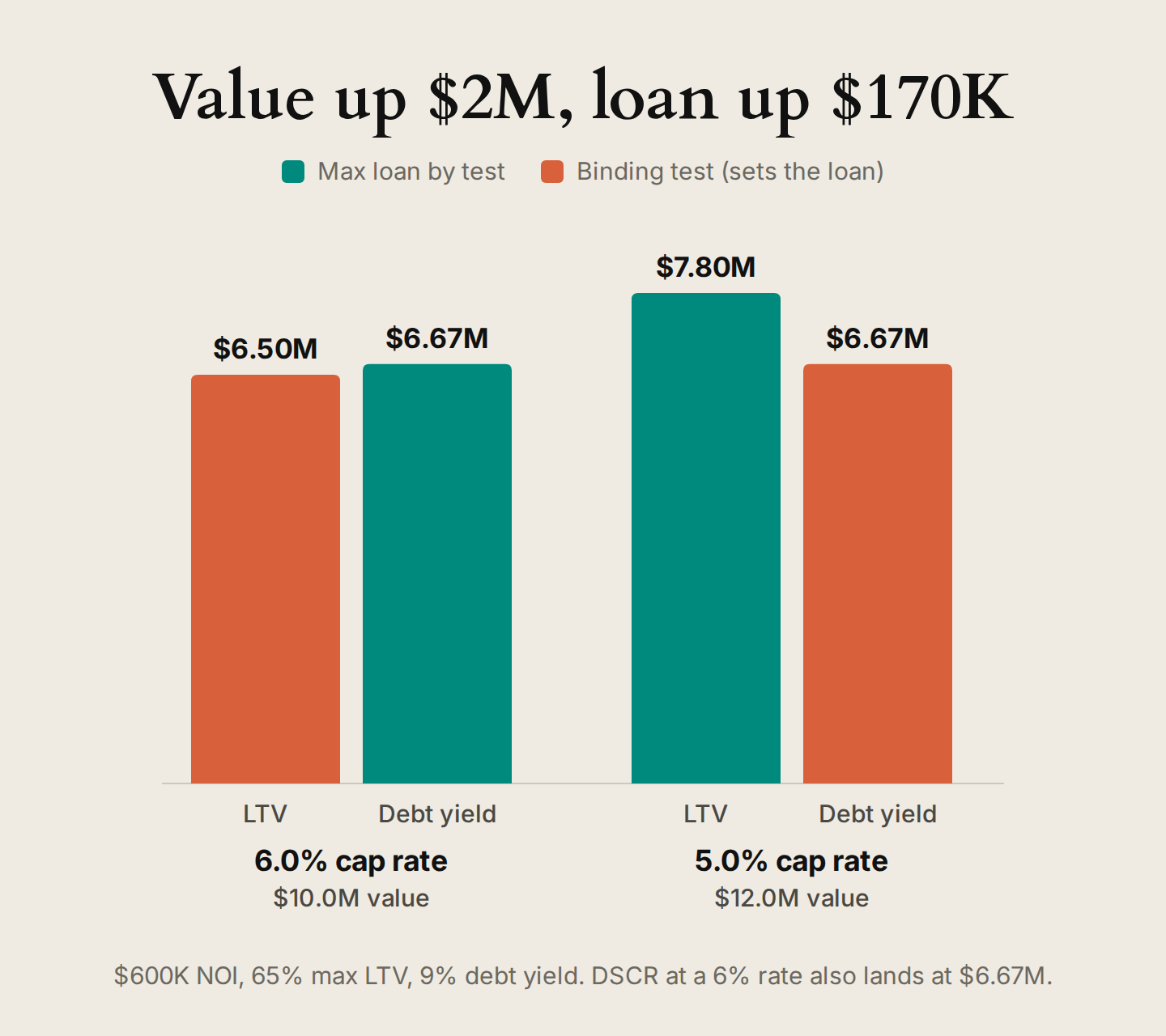
Say a property earns $600,000 of NOI. At a 6.0% cap rate it’s worth $10 million, and 65% LTV allows a $6.5 million loan. Drop the cap rate to 5.0% and the value climbs to $12 million, so LTV would allow $7.8 million. But a 9% minimum debt yield caps the loan at about $6.67 million, and at a 6.0% interest rate with 1.25x coverage, DSCR lands in the same spot. Value went up $2 million, and the loan went up only about $170,000. At higher rates, DSCR would cap the loan lower still.
The flip side: when value drops, the refinance gap appears
The relationship cuts both ways at refinance. If market cap rates rise between your original loan and maturity, your value falls even with flat income, and the LTV-based loan falls with it. If LTV becomes your binding constraint, the new loan may not cover the balance coming due.
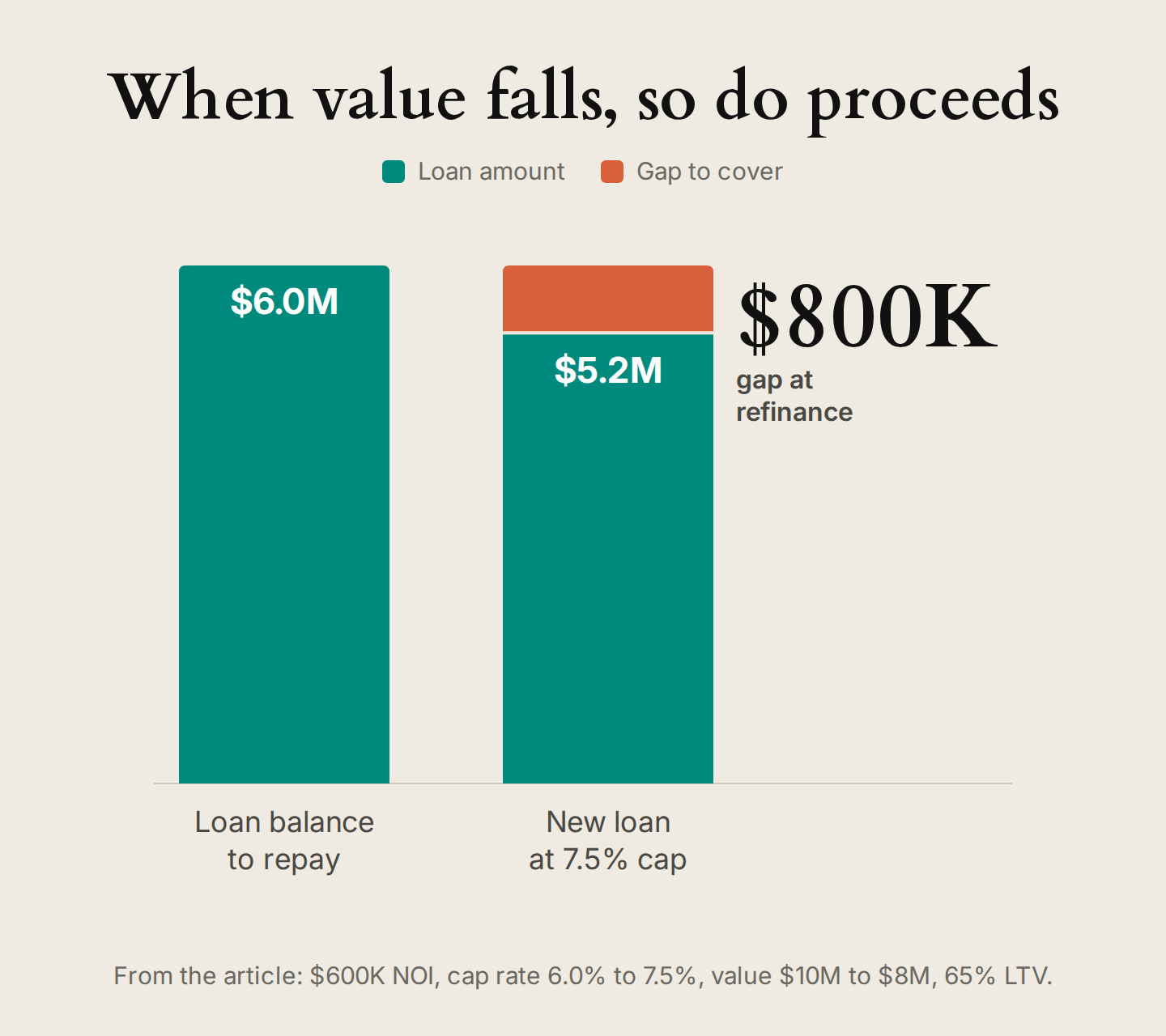
A worked example: a property with $600,000 NOI valued at $10,000,000 (6.0% cap) might support a $6.5M loan at 65% LTV. If cap rates move to 7.5%, the value drops to $8,000,000, and the 65% LTV loan falls to $5.2M. A $6,000,000 balance maturing into that market faces an $800,000 gap. That’s money the new senior loan won’t cover, and it’s why many refinances turn into a cash-in refi. Model this in the Refinance Proceeds Calculator and the Financing Gap tool.
What to do about it
- Know which test binds before you act. If income binds, raising value won’t help, so grow NOI instead. If LTV binds, a stronger value (or more time for the market) is the lever.
- Stress your refinance early. Test your maturity against a higher cap rate so a value decline doesn’t surprise you at the worst moment.
- Plan for the gap, don’t react to it. If a refinance gap is possible, identify it well ahead of maturity so you have time and options.
How Mercury helps
We show you how value and income each drive your loan proceeds, identify the binding constraint, and stress-test your refinance so a cap rate move doesn’t catch you short. Then we run a competitive process with senior lenders. Try the Refinance Proceeds Calculator, then discuss your financing scenario.
Frequently asked questions
Loan proceeds are the amount a lender funds on a loan, before closing costs and reserves come out. On a commercial real estate loan, the maximum proceeds are the lowest of the amounts allowed by the DSCR, debt yield, and LTV tests. Net proceeds are what’s left after closing costs, lender reserves, and payoff of any existing loan.
The maximum loan on a commercial property is the lowest of three tests: DSCR, debt yield, and LTV. The DSCR test divides NOI by the minimum coverage ratio to get the most annual debt service allowed, then converts that into a loan amount at the loan’s rate and amortization. The debt yield test divides NOI by the minimum debt yield. The LTV test multiplies the appraised value by the maximum LTV.
No, a higher property value only raises the LTV-based loan. If DSCR or debt yield is your binding constraint, income caps your loan proceeds no matter what the property appraises for.
A refinance gap is the shortfall when the largest new loan a property supports is less than the balance coming due on the existing loan. It usually comes from rising cap rates, which lower value, higher interest rates, which tighten DSCR, or a drop in NOI, which hurts every test.
Rising interest rates cut refinance proceeds two ways: higher debt service squeezes DSCR, and higher cap rates lower value and the LTV-based loan. Both can reduce your loan proceeds and open a gap.
If your property won’t refinance for enough, you can bring cash to closing (a cash-in refinance), ask your current lender for an extension, raise NOI before you refinance, or find a lender that sizes the deal differently. Which one fits depends on how big the gap is and how much time you have before maturity.