
How to read a commercial real estate term sheet line by line, and how to compare offers when the rates are close.
A commercial real estate term sheet is a lender’s written summary of the loan it’s prepared to offer. It’s usually non-binding, but it sets the terms you’ll negotiate and close against. Read it carefully and compare offers line by line, because the lowest rate isn’t always the best deal once the rest of the structure is on the table.
The lines that matter on a commercial real estate term sheet
Loan amount. The proceeds offered, often shown alongside the LTV, LTC, DSCR, or debt yield used to size it. Check which constraint drove the number.
Interest rate. Fixed or floating. Floating rates are quoted as a spread over an index (for example, SOFR + 250 bps). Watch for rate locks, floors, and caps.
Index and spread. For floating-rate loans, the index moves with the market; the spread is fixed. A rate cap may be required, at a cost.
Amortization. The schedule used to compute the payment, commonly 25 or 30 years, which may be longer than the loan term.
Term / maturity. When the loan comes due, often 5, 7, or 10 years, usually with a balloon payment of the remaining balance.
Interest-only period. Any months of interest-only payments before amortization begins. IO vs. amortizing
Recourse vs. non-recourse. Whether the borrower is personally liable beyond the collateral. Non-recourse loans still carry “bad-boy” carve-outs for fraud, bankruptcy, and similar.
Reserves and escrows. Required holdbacks for taxes, insurance, replacement reserves, tenant improvements, leasing commissions, or interest during lease-up. These reduce net proceeds.
Prepayment terms. How costly it is to pay off early: yield maintenance, defeasance, or a step-down penalty (for example, 5%-4%-3%-2%-1%). This matters a lot if you might sell or refinance.
Fees. Origination, application, legal, and third-party costs (appraisal, environmental, engineering). They add up.
Conditions and covenants. Closing conditions, ongoing financial covenants, reporting requirements, and any DSCR or occupancy tests the borrower must maintain.
Why two term sheets are hard to compare on rate alone
A loan that’s 25 basis points cheaper can be the worse deal if it carries lower proceeds, full recourse, onerous prepayment, or heavy reserves. Real comparison means normalizing all of it: net proceeds after reserves and fees, the true cost of capital including prepayment flexibility, and the structure’s fit with your hold and exit plan.
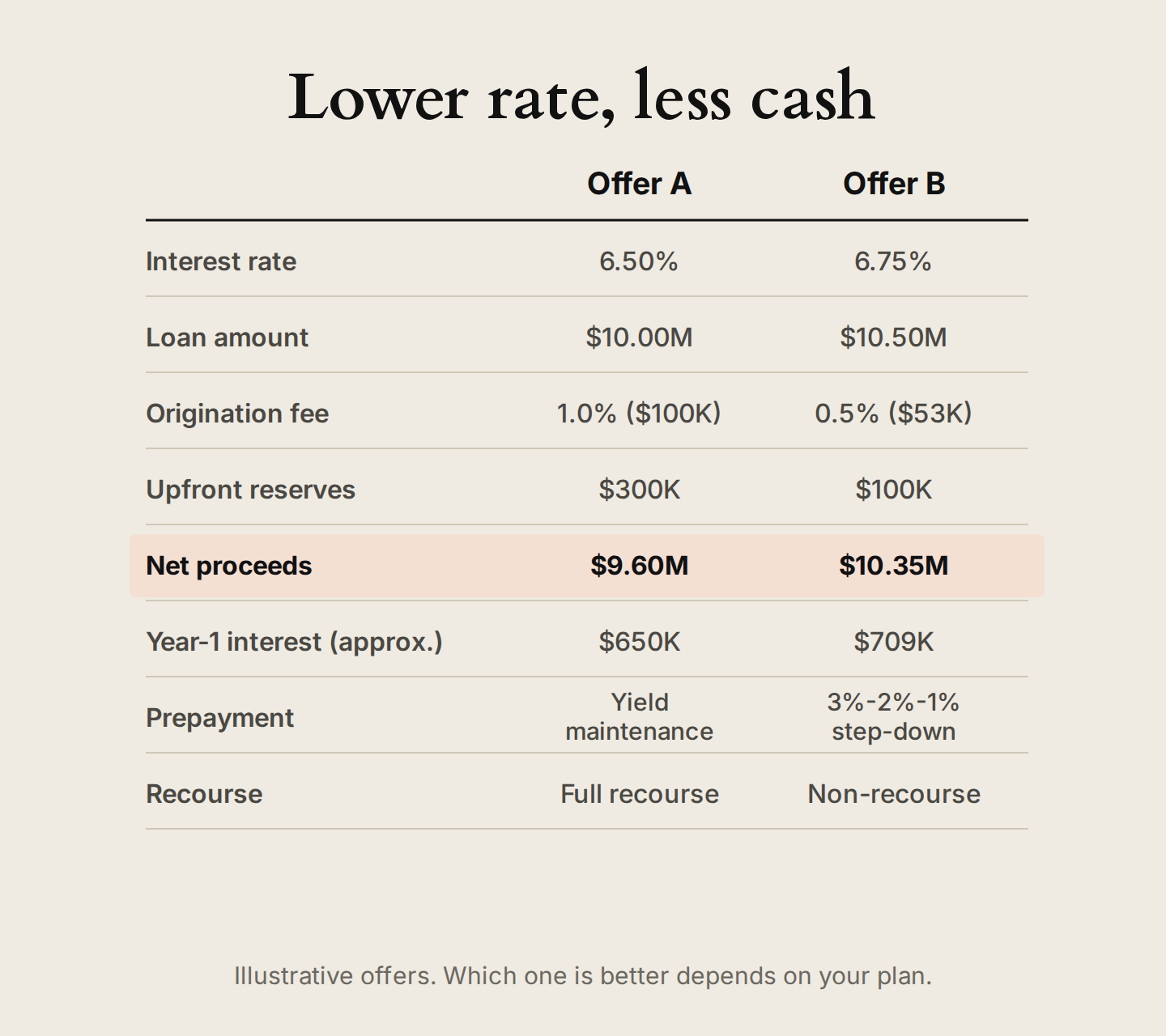
In the example below, Offer A has the lower rate. But Offer B lends $500,000 more and takes less in fees and reserves, so A puts about $750,000 less cash in your hands at closing. If you’ll hold for the full term, A’s interest bill runs about $59,000 a year less, and the reserves still go toward your property’s own costs. If you might sell or refinance early, B’s extra proceeds and lighter prepayment terms probably matter more.
Remember: a term sheet usually isn’t a commitment
Most term sheets are non-binding indications, subject to underwriting, appraisal, and committee approval, and terms can change before closing. That’s why a competitive process matters. Competing term sheets give you leverage and a fallback if one lender retrades.
This explainer is part of our complete guide to commercial real estate financing.
How Mercury helps
We gather term sheets from multiple senior lenders, put them on the same basis so you’re comparing real economics rather than headline rates, and negotiate the structure as well as the price through to closing. Discuss your financing scenario.
Frequently asked questions
A commercial real estate term sheet, also called a loan term sheet, is a lender’s written summary of the loan it’s prepared to offer. It lists the amount, rate, term, amortization, recourse, reserves, prepayment terms, fees, and conditions. It’s usually non-binding, but it sets the framework you’ll negotiate and close against, so it deserves a careful line-by-line read.
No, a term sheet usually isn’t a loan commitment. Most are non-binding indications subject to underwriting, appraisal, and credit approval. A formal commitment comes later, after diligence, and even then it carries conditions you have to meet before the loan closes. Signing one can still commit you to a deposit or an exclusivity period, so read those clauses.
Yield maintenance is a prepayment penalty that makes the lender whole for interest lost when you prepay a fixed-rate loan. It’s roughly the present value of the gap between your loan rate and current Treasury yields over the remaining term, so it’s largest when rates have fallen. Most formulas set a floor, often 1% of the prepaid balance.
Prepayment terms and reserves are the most overlooked parts of a term sheet. Both can matter more than a small difference in rate: a yield maintenance or defeasance payment can be large if you sell or refinance early, and upfront reserves tie up cash you’d otherwise receive at closing.
You shouldn’t accept the first term sheet without comparing it to others. A competitive process often produces better terms, shows you what the market will really do, and gives you a fallback if a lender changes its offer before closing. The exception is a tight deadline, where certainty of closing can outweigh a slightly better rate.
A rate cap is a hedge you buy on a floating-rate loan that pays you the difference when the index, usually SOFR, rises above an agreed strike rate. Lenders usually require one, and it can be expensive when rates are volatile. The term sheet should state the strike, the cap’s term, and when you’ll need to buy a replacement.