
DSCR is net operating income divided by annual debt service. Learn what lenders expect by property type and how the ratio sets the size of your loan.
Debt service coverage ratio (DSCR) measures whether a property’s income covers its loan payments. It’s the first number most commercial lenders look at, and it often decides how large a loan they’ll offer.
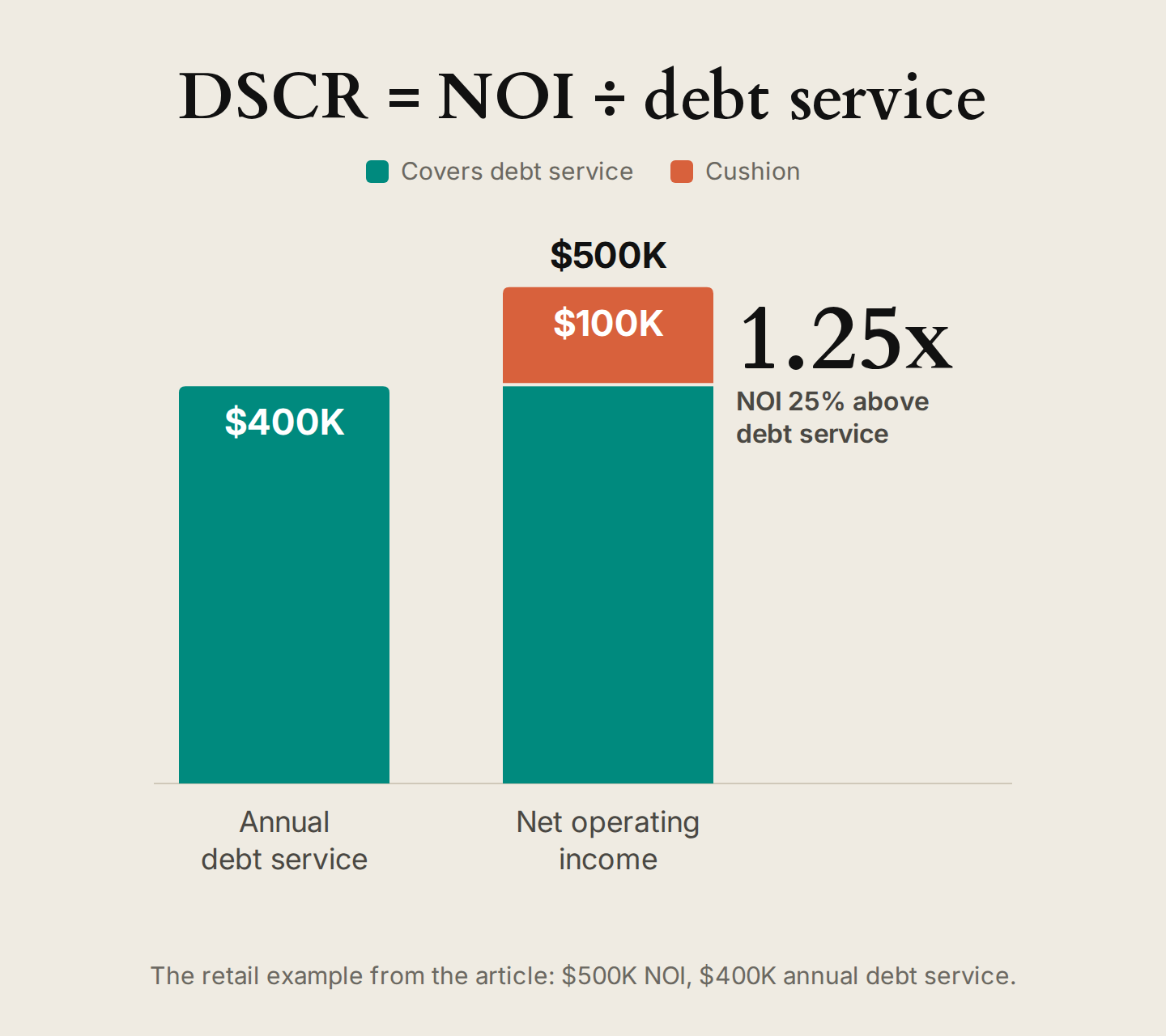
A DSCR of 1.25x means the property generates 25% more income than it needs to cover its annual debt service. At 1.00x, income exactly covers the payment with no cushion. Below 1.00x, the property doesn’t earn enough to pay its own debt.
A quick example
A retail property produces $500,000 in NOI and carries $400,000 in annual debt service (principal and interest).
That 1.25x tells the lender the property has a 25% income cushion above the payment. Run your own numbers in the DSCR Calculator.
What counts as a good DSCR in commercial real estate?
There’s no universal number. It depends on property type, risk, and the lender. As a rough guide, stabilized senior lenders often look for minimums in this range:
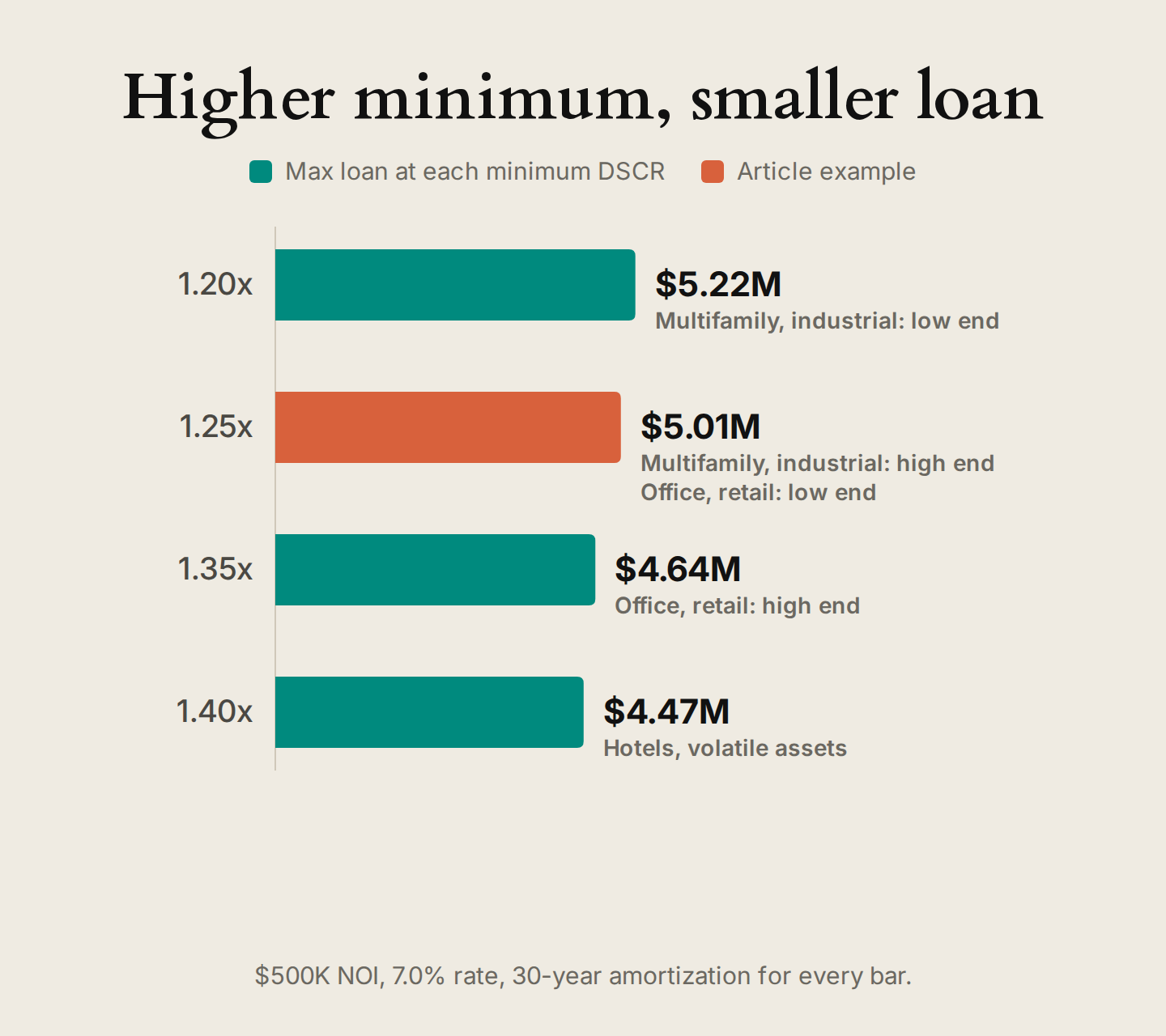
- Multifamily and industrial: around 1.20x–1.25x
- Office and retail: around 1.25x–1.35x
- Hotels and other higher-volatility assets: 1.40x or higher
Riskier cash flows demand more cushion. A property with long-term credit leases supports a lower DSCR than one living on short-term, turnover-heavy income.
How lenders use DSCR to size a loan
Lenders use DSCR to set maximum loan proceeds. They take the property’s NOI, divide by their minimum DSCR to find the largest debt service the property can carry, then convert that into a loan amount using the rate and amortization.
So a property with $500,000 NOI and a 1.25x minimum can carry at most $400,000 of annual debt service; whatever loan that payment supports is the DSCR-constrained maximum. DSCR is frequently the binding constraint, especially when rates are high. See how lenders size CRE loans for how it stacks up against debt yield and LTV.
The minimum itself matters. On the same $500,000 of NOI at a 7% rate with 30-year amortization, moving from a 1.20x to a 1.40x minimum cuts the maximum loan from about $5.22 million to $4.47 million, roughly $750,000 less.
Things that trip people up
- NOI, not cash flow after debt. DSCR uses net operating income, which is income after operating expenses but before debt service and capital items. Don’t subtract the mortgage before you calculate it. Some lenders, CMBS in particular, deduct reserves first and size on net cash flow, which lowers the ratio.
- Annual, not monthly. Use the full year’s NOI and the full year’s debt service. Monthly figures work too, as long as both sides match.
- Interest-only changes the picture. During an interest-only period, debt service is lower, so DSCR looks higher. Many lenders size to the fully amortizing payment anyway.
- Stress rates. Some lenders calculate DSCR using a rate above today’s market rate to guard against future increases, which lowers the loan they’ll offer.
How Mercury helps
DSCR is one of three tests that determine your loan. We model all of them, identify which one limits your deal, and structure the request around it. Then we run a competitive process among senior lenders. Start with the DSCR Calculator, then discuss your financing scenario.
Frequently asked questions
DSCR, or debt service coverage ratio, is a property’s net operating income divided by its annual debt service. In commercial real estate, lenders use it to check that a property’s income covers its loan payments with room to spare, and to cap how much they’ll lend against that income.
To calculate DSCR, divide the property’s annual net operating income by its annual debt service, meaning principal plus interest. For example, $500,000 of NOI against $400,000 of annual debt service gives a DSCR of 1.25x. Use NOI before debt service and capital items, and keep both numbers on the same annual or monthly basis.
A good DSCR for a commercial loan usually means clearing a lender minimum of about 1.20x to 1.40x or more, depending on property type and risk. Multifamily and industrial sit toward the low end, office and retail in the middle, and hotels at 1.40x or higher. Coverage above the minimum gives you room if income dips.
A 1.25x DSCR means the property’s net operating income is 25% higher than its annual debt service. For example, $500,000 of NOI against $400,000 of annual payments is 1.25x, which leaves a $100,000 cushion before income would fall short of the payment.
A higher DSCR is safer for the lender, but it isn’t always better for the borrower. A very high DSCR can mean you’re borrowing less than the property could support. Whether that matters depends on your goals for cash flow, leverage, and risk.
DSCR factors in your interest rate and amortization, while debt yield ignores both and divides NOI by the loan amount. That’s why DSCR moves when rates change and debt yield doesn’t. Lenders use both: DSCR tests payment coverage, and debt yield keeps low rates or long amortization from inflating the loan.
A DSCR loan usually means a residential investor mortgage on a one- to four-unit rental, qualified on the property’s rent rather than the borrower’s personal income. Commercial real estate loans are sized on the same idea, with NOI covering debt service by a set margin, though most lenders also weigh the sponsor’s experience and finances.