
Lenders stress-test commercial real estate loans at a higher rate, on a lower NOI, and against a future refinance. The result is often less than today’s numbers show.
When lenders size your loan, they don’t take today’s rate or in-place income at face value. They size to a higher “stress rate,” haircut the income, and test what happens at refinance. That’s why the loan you’re offered can land below what current numbers seem to support.
Here are the main stress tests and how each one moves your proceeds.
Stress test 1: the underwriting (stress) rate
The most common one. Rather than sizing DSCR on the actual note rate, many lenders use a stress rate set above the note rate. It might be today’s rate plus a fixed spread, or a floor (for example, “the greater of the note rate plus 1% or 7.5%”).
A higher sizing rate means a higher assumed debt service, which lowers the loan that passes the DSCR test:
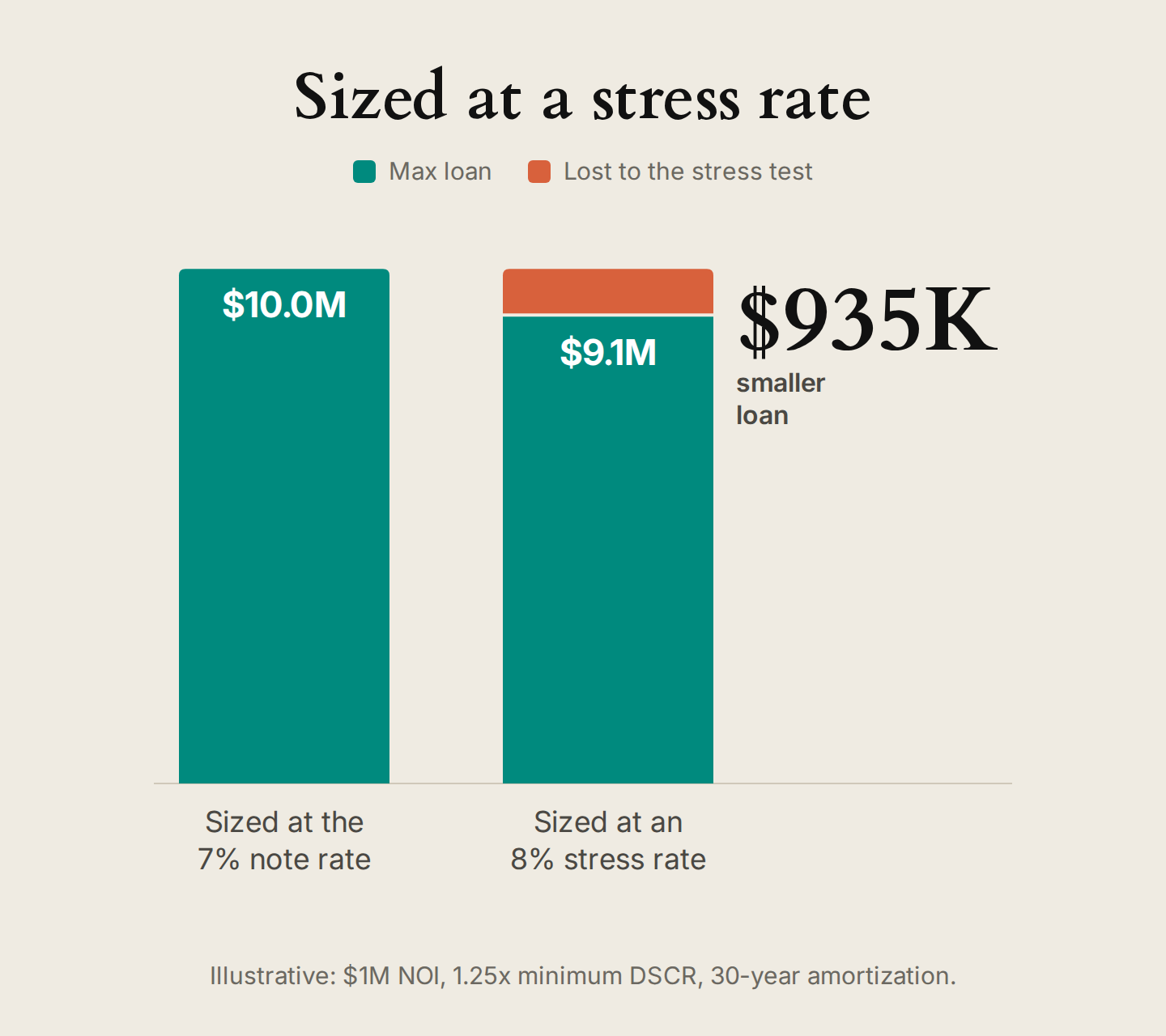
Because the mortgage constant rises with the rate, sizing at 8% instead of 7% produces a smaller DSCR-supported loan even though your actual payment is based on 7%. On $1 million of NOI at a 1.25x minimum DSCR and 30-year amortization, that’s about $9.1 million instead of $10.0 million. The Loan Sizing Calculator lets you enter a stress rate to see the effect.
Stress test 2: the refinance / exit test
For loans with a balloon, lenders care whether the property can refinance at maturity. They test a refinance constant or exit DSCR at an assumed future rate, confirming projected income would still support a take-out loan large enough to repay the balance. A deal that only works at today’s low rate may fail the exit test and get sized down.
Stress test 3: income haircuts
Lenders rarely take a rent roll at face value. Common adjustments:
- Vacancy floor. Even a fully leased building is underwritten with a market vacancy assumption, often 5% to 10%.
- Mark-to-market rents. Above-market in-place rents may be trimmed to market for sizing.
- Tenant credit and rollover. Income from weak-credit or near-term-expiring tenants may be discounted or excluded.
- Reserves and capital items. Management fees, replacement reserves, and TI/LC allowances come out to reach the NOI used for sizing, which is often lower than an owner’s pro forma NOI.
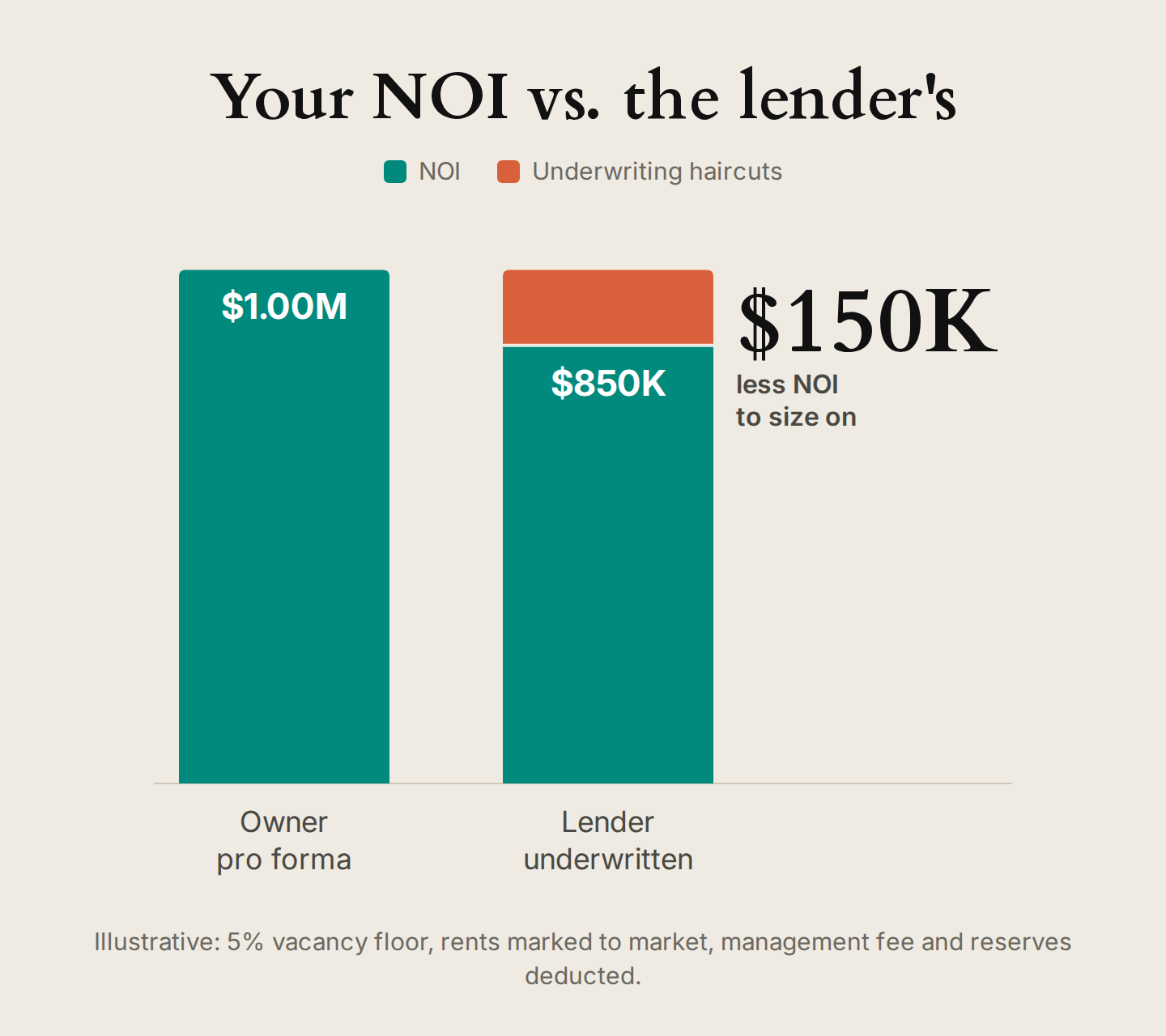
The result is an underwritten NOI that can sit meaningfully below the number an owner would quote, and it flows straight through DSCR and debt yield. In the illustration below, a $1.0 million pro forma NOI underwrites to $850,000, and at a 1.25x minimum and a 7% rate that alone cuts the DSCR-supported loan by about $1.5 million.
Stress test 4: cap rate / value sensitivity
On the value side, an appraiser and lender may apply a cap rate above recent comps to stay conservative, lowering the value used for the LTV test. A higher cap rate means a lower value, which can pull the LTV-supported loan down.
Why this matters for borrowers
Stress-testing is the gap between “what my numbers say I should get” and “what the term sheet says.” Understanding it lets you:
- Underwrite to the lender’s NOI, not your pro forma. Apply a realistic vacancy factor and reserves before you estimate proceeds.
- Ask about the stress rate up front. Two lenders quoting the same note rate can size very differently if one uses a 7.5% floor and the other sizes to the actual rate.
- Plan for the exit. If your deal only pencils at today’s rate, expect a smaller loan or a structure that addresses refinance risk.
How Mercury helps
We underwrite your deal the way a lender will, with realistic income adjustments and stress rates, so the proceeds estimate you walk in with is one you can actually close. Then we run a competitive process among senior lenders to find the one whose stress assumptions fit your asset best. Model a stress rate in the Loan Sizing Calculator, then discuss your financing scenario.
Frequently asked questions
A stress rate is an interest rate above the note rate that lenders use to size a commercial real estate loan as a cushion against rising rates. Higher assumed debt service means a smaller DSCR-supported loan. On $1 million of NOI at 1.25x DSCR and 30-year amortization, sizing at 8% instead of 7% cuts the loan by about $935,000.
Your underwritten NOI is lower because lenders apply a vacancy floor, mark above-market rents down to market, deduct management fees and replacement reserves, and may discount income from weak or soon-expiring tenants. The result is usually more conservative than an owner’s pro forma, and it flows straight into the DSCR and debt yield tests.
An exit or refinance test checks whether the property could refinance at maturity, at an assumed future rate, and still support a loan big enough to repay the balloon. Lenders run it on loans with a balloon payment, and a deal that only works at today’s rate may be sized down to pass it.
Lenders typically underwrite vacancy and credit loss at the greater of actual, market, or a floor of about 5% to 10%, even when a building is fully leased, and more for weaker markets or assets with heavy lease rollover. The exact figure depends on the property type, the local market, and the lender’s own policies.
No, not all lenders use a stress rate. Some size on the actual note rate, while others add a spread or set a floor. On floating-rate loans, many size to the all-in rate at the cap strike (strike plus spread) or the forward curve. That’s why two lenders quoting the same note rate can offer different loan amounts.
If a stress test cuts your proceeds, look for lenders that size on the actual rate or a lower floor, support your NOI with leases and documented expenses, and ask whether longer amortization changes the sizing. Interest-only periods seldom help, since lenders that stress-test usually size on an amortizing payment. A competitive process shows which lenders fit your deal.