
Typical loan-to-value maximums by lender, how LTV differs from LTC, and when value rather than income limits your loan.
Loan-to-value, or LTV, measures the size of a loan relative to the property’s value. It’s the most familiar of the three loan-sizing tests, and it caps how much a lender will advance against the asset’s worth.
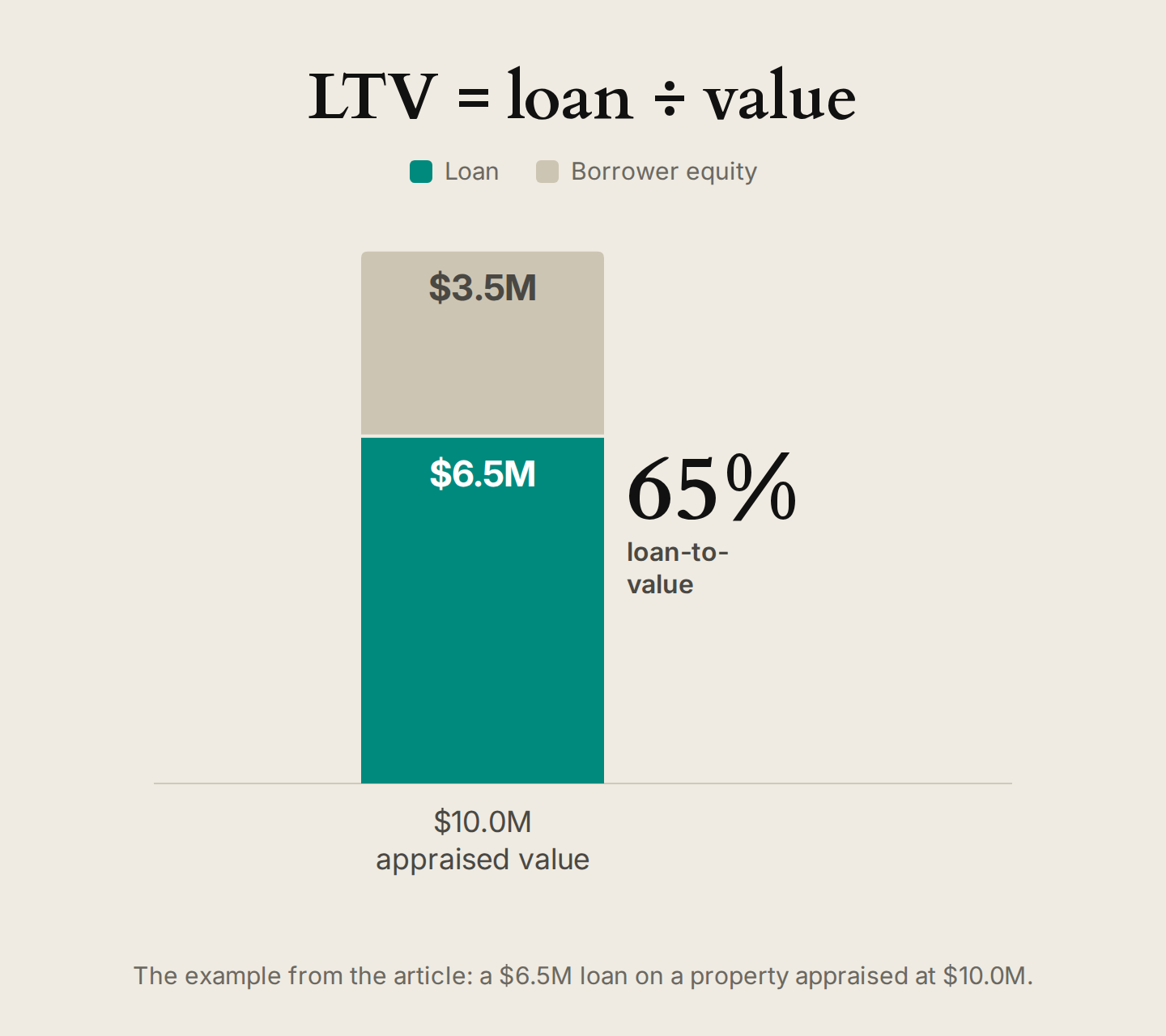
A $6,500,000 loan on a property appraised at $10,000,000 is a 65% LTV. Flip the formula to find the maximum loan a value supports:
Typical maximum LTV
How high an LTV a lender will go depends on the asset, the lender, and the market. As a general guide for stabilized assets:
- Life companies: roughly 55% to 65%
- Banks and CMBS: roughly 65% to 75%
- Agency multifamily: 75% to 80%
Higher-risk or transitional assets are held to lower LTVs; the strongest, most stable assets command the highest. The remaining percentage is the equity the borrower brings.
LTV vs. LTC: don’t mix them up
For a purchase or development, lenders also look at loan-to-cost (LTC), which measures the loan against total project cost rather than appraised value.
On a development that creates value, LTC and LTV can diverge sharply. A project that costs $6,000,000 but stabilizes at a $7,500,000 value might be 70% LTC ($4.2M) yet only 56% LTV at stabilization. Lenders frequently size to the lower of an LTC limit during construction and an LTV limit at stabilization.
When LTV is the binding constraint
LTV tends to limit the loan when a property trades at a high cap rate, so value is low relative to income. The income could support more debt, but the value can’t, and a stronger appraisal raises your proceeds until an income test takes over. At a low cap rate it’s the reverse: value supports a large loan, but the income-based tests (DSCR and debt yield) cap proceeds below the LTV ceiling, and a higher appraisal won’t help.
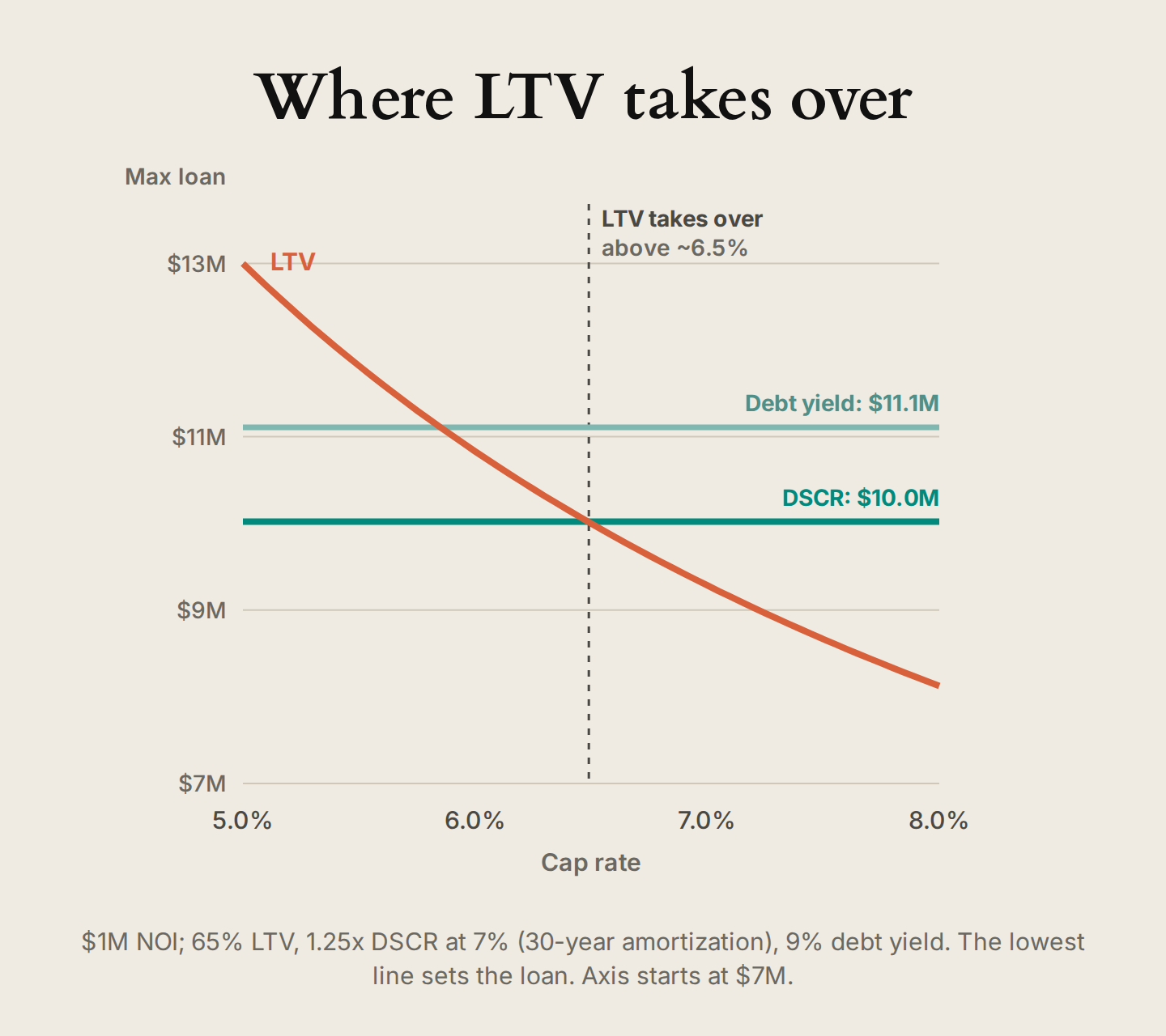
LTV bites hardest when values fall. If a property’s value drops at refinance, the maximum LTV-based loan drops with it, which can create a refinance gap even if income is steady. See how value drives loan proceeds and DSCR vs. debt yield vs. LTV.
How Mercury helps
We test LTV against DSCR and debt yield to show which one actually limits your loan, and we structure the request around it. Then we run a competitive process among senior lenders. Run your numbers in the Loan Sizing Calculator, then discuss your financing scenario.
Frequently asked questions
In commercial real estate, loan-to-value (LTV) is the loan amount divided by the property’s appraised value, shown as a percentage. It’s one of the three main tests lenders use to size a loan, alongside DSCR and debt yield, and it sets the most a lender will advance against what the property is worth.
To calculate loan-to-value, divide the loan amount by the property’s appraised value and multiply by 100. A $6.5 million loan on a $10 million property is a 65% LTV. To find the largest loan a lender allows, flip it: multiply the appraised value by the lender’s maximum LTV.
A good loan-to-value ratio for a stabilized commercial property is usually 55% to 75%, depending on the lender and property type. Life companies tend to stop around 55% to 65%, banks and CMBS lenders around 65% to 75%, and agency multifamily can reach 80%. A lower LTV often gets better pricing and more room if the value dips.
LTV compares the loan to the property’s appraised value, while LTC compares it to the total project cost. For development and heavy value-add deals, lenders often size to the lower of an LTC limit during construction and an LTV limit on the as-stabilized value, so both numbers matter.
A higher appraisal increases your loan only when LTV is the binding constraint, which usually happens when the property trades at a high cap rate. If DSCR or debt yield limits the loan, a higher value doesn’t add proceeds, because the income tests cap the loan first.
LTV limits your loan when value is low relative to income, which usually means a high cap rate or a low appraisal. With $1 million of NOI, 1.25x DSCR at 7% on a 30-year amortization, a 9% debt yield floor, and 65% maximum LTV, LTV becomes the binding test above roughly a 6.5% cap rate.