
Commercial real estate loan types line up with five kinds of lenders: banks, life companies, agencies, debt funds, and CMBS conduits. What each one offers, and how to match your deal to the right one.
There’s no single “commercial mortgage.” The right loan depends on the asset, the business plan, and where the property sits in its life cycle. Every lender type has its own appetite for risk, leverage, and structure, and matching the deal to the right one is most of the job.
Banks and credit unions
The most common starting point. Banks and credit unions are relationship lenders that offer competitive rates and flexibility, especially on smaller, local, and stabilized deals.
- Best for: acquisition and refinance of stabilized assets; construction for established sponsors; local deals.
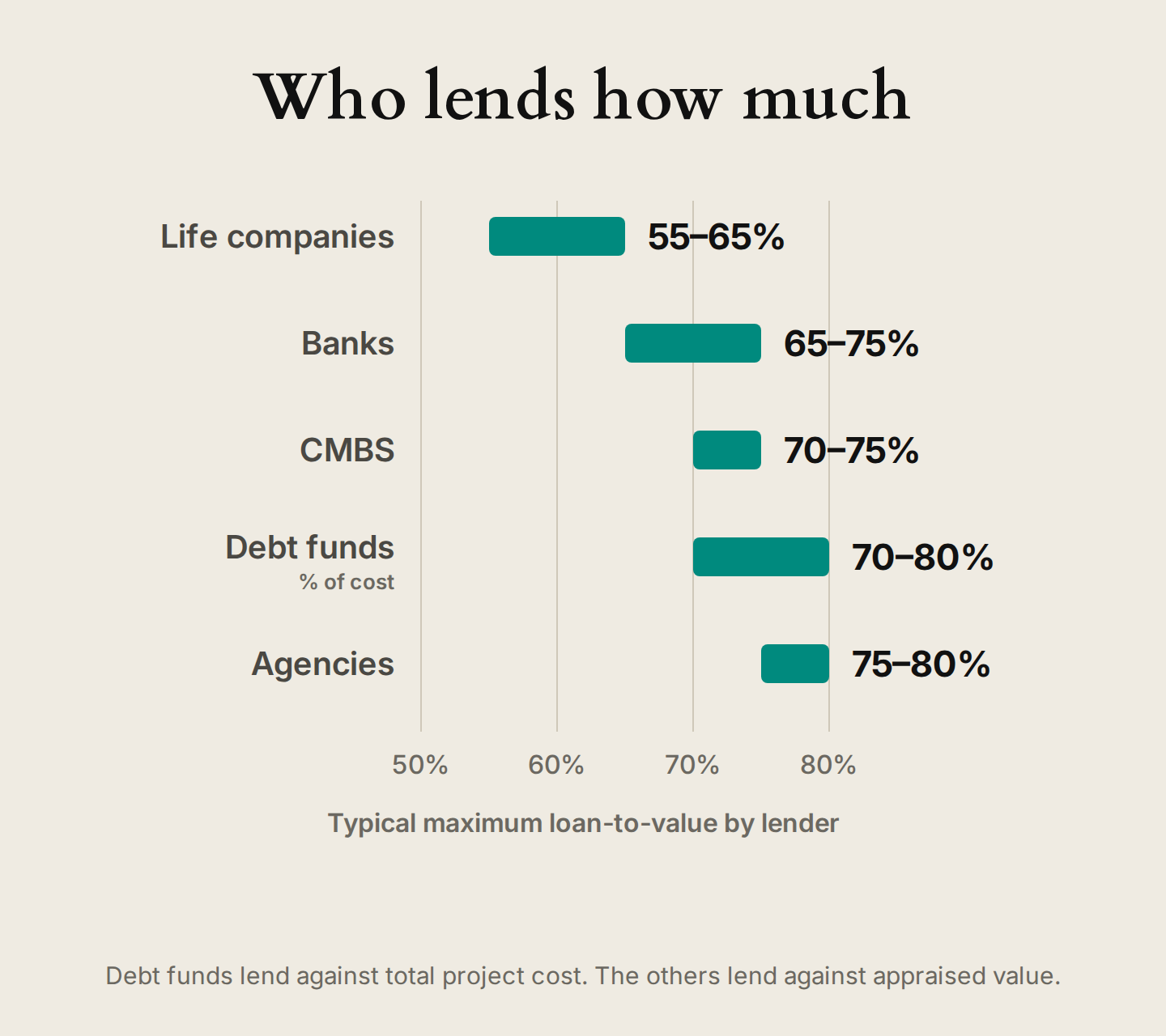
- Leverage: moderate, often up to 65% to 75% LTV.
- Recourse: frequently full or partial recourse.
- Trade-off: relationship-driven and flexible, but leverage and terms vary widely by institution and balance-sheet appetite.
Life insurance companies
Life companies lend their own long-term capital and prize stability, offering some of the lowest fixed rates available on conservative terms.
- Best for: high-quality, stabilized assets with durable income.
- Leverage: conservative, often 55% to 65% LTV.
- Recourse: typically non-recourse.
- Trade-off: excellent rate and certainty, but lower leverage and selective on asset quality and location.
Agencies (Fannie Mae, Freddie Mac, HUD)
The dominant source for multifamily. Agency execution offers attractive rates, high leverage, and long terms.
- Best for: multifamily, including affordable and seniors housing.
- Leverage: high, often up to 75% to 80%.
- Recourse: typically non-recourse.
- Trade-off: outstanding terms for qualifying multifamily, but program rules and timelines are specific.
Debt funds and bridge lenders
Flexible, fast capital for assets that aren’t stabilized yet, such as value-add, lease-up, repositioning, or construction deals.
- Best for: transitional and value-add deals; speed and certainty of execution.
- Leverage: higher, often up to 70% to 80% of cost.
- Recourse: often non-recourse with carve-outs.
- Trade-off: higher rate (usually floating over SOFR), but flexibility and speed balance-sheet lenders can’t match.
CMBS (conduit) lenders
Loans pooled and sold into commercial mortgage-backed securities, built for stabilized, cash-flowing assets that fit standard underwriting.
- Best for: stabilized assets seeking fixed-rate, non-recourse debt, including secondary markets.
- Leverage: up to roughly 70% to 75% LTV.
- Recourse: non-recourse with standard carve-outs.
- Trade-off: competitive fixed rate and leverage, but rigid servicing and prepayment (defeasance or yield maintenance).
Which one fits your deal?
| Lender | Sweet spot | Leverage | Rate | Recourse |
|---|---|---|---|---|
| Bank / credit union | Stabilized, local, smaller | Moderate | Competitive | Often recourse |
| Life company | Best-in-class stabilized | Lower | Lowest fixed | Non-recourse |
| Agency | Multifamily | High | Attractive | Non-recourse |
| Debt fund / bridge | Transitional / value-add | Higher | Higher (floating) | Non-recourse + carve-outs |
| CMBS | Stabilized, fixed, non-recourse | Up to ~75% | Competitive fixed | Non-recourse |
The point of a competitive process is that two of these lenders will quote your deal very differently, and the cheapest rate isn’t always the best choice once you weigh leverage, recourse, and flexibility.
This explainer is part of our complete guide to commercial real estate financing.
How Mercury helps
We know which commercial real estate lenders are active for your asset type, market, and business plan. We run a competitive process among senior lenders to find the best fit. The best fit is rarely the first quote. Discuss your financing scenario.
Frequently asked questions
The main types of commercial real estate loans, grouped by lender, are bank and credit union loans, life insurance company loans, agency loans (Fannie Mae, Freddie Mac, and HUD), bridge loans from debt funds, and CMBS or conduit loans. They differ mainly in leverage, rate, recourse, term, and how flexible they are about the property’s condition.
The cheapest source of commercial real estate debt is usually a life insurance company, or an agency lender for multifamily, since both offer some of the lowest fixed rates. Life companies are selective and conservative on leverage, and agency programs only cover eligible multifamily, so the lowest rate can come with lower proceeds or tighter terms.
A value-add deal usually fits a debt fund or bridge lender, which offers higher leverage, often based on total cost, and faster closings for properties that aren’t stabilized yet. The usual exit is a refinance into permanent debt from a bank, life company, agency, or CMBS lender once the property is stabilized, or a sale.
Commercial real estate loans can be recourse or non-recourse, depending on the lender. Banks and credit unions often require full or partial recourse, while life companies, agencies, debt funds, and CMBS lenders typically lend non-recourse with standard carve-outs for fraud, bankruptcy, and similar bad acts. Construction and heavy value-add loans may still carry completion or partial guarantees.
A CMBS loan, also called a conduit loan, is a fixed-rate commercial mortgage that the lender pools with other loans into a trust that issues bonds, called commercial mortgage-backed securities, to investors. It’s typically non-recourse with standard carve-outs and offers competitive leverage, but servicing is rigid and paying it off early usually means defeasance or yield maintenance.
An agency loan is a multifamily loan made under a Fannie Mae, Freddie Mac, or HUD program by an approved lender, which originates and usually services it; the agency buys or insures the loan. Agency loans offer low rates, high leverage, and long terms, and they’re typically non-recourse, but each program has its own eligibility rules and timelines.