
NOI and cap rate are where your loan amount starts. Learn what each one measures and what a move in market cap rates can do to your next refinance.
Net operating income (NOI) and cap rate sit underneath almost every commercial real estate decision. Together they set what a property is worth and how much debt it can support. Most owners think of NOI and cap rate as valuation tools, but lenders use the same two numbers to size your loan.
Net operating income (NOI)
NOI is the income a property generates after operating expenses, but before debt service and capital items.
Effective gross income is your potential rent plus other income, less vacancy and credit loss. Operating expenses include taxes, insurance, management, maintenance, and utilities. They do not include your mortgage payment, capital improvements, or depreciation. Run it in the NOI Calculator.
A lender’s sizing math starts with NOI. The two income-based loan tests, DSCR and debt yield, both use it directly, so a change in NOI moves your value, your DSCR, and your debt yield at once.
Cap rate
The capitalization rate links income to value. It’s the property’s unleveraged yield, the first-year return a buyer would earn paying all cash.
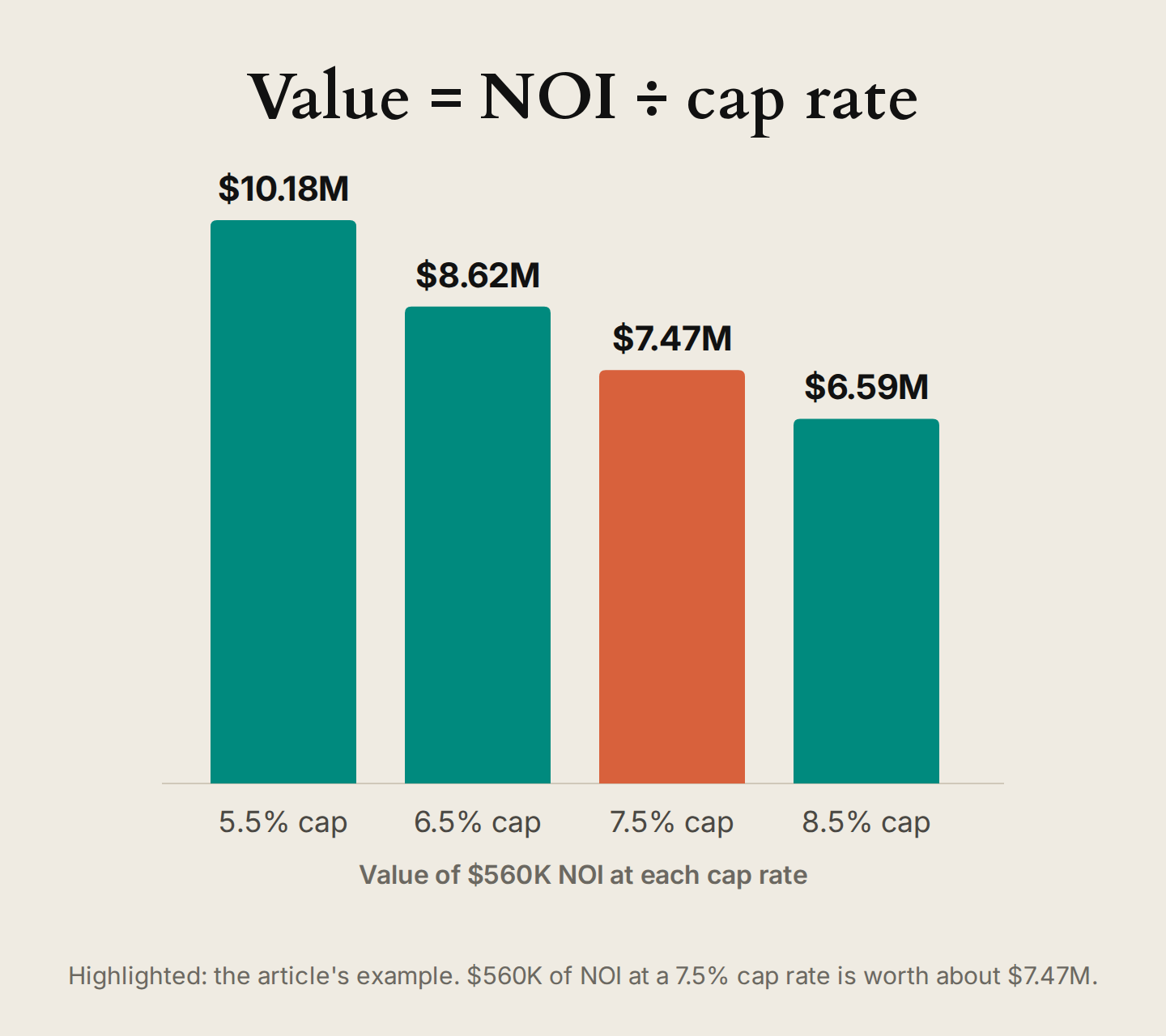
A property with $560,000 of NOI at a 7.5% cap rate is worth about $7.47 million ($560,000 ÷ 0.075). Lower cap rates mean higher values for the same income; higher cap rates mean lower values. The market sets cap rates. They vary by property type, location, and quality, and they tend to move with interest rates, though with a lag and not one for one. Use the Cap Rate Calculator to solve either direction.
How the two flow into your loan
The same two numbers also drive all three loan-sizing tests:
- NOI → DSCR. DSCR is NOI divided by debt service. Higher NOI supports a larger DSCR-based loan.
- NOI → debt yield. Debt yield is NOI divided by the loan. Higher NOI raises the debt-yield ceiling.
- NOI + cap rate → value → LTV. Cap rate turns NOI into value, and value sets the LTV-based loan.
So one number, NOI, feeds all three tests, and cap rate turns it into the value the LTV test uses. That’s why NOI is the lever you control. Raise it and your value and loan capacity rise together. See how lenders size CRE loans and how property value drives loan proceeds.
Why cap rate movement matters for your debt
Because cap rate sets value, a move in market cap rates changes your value, and with it your LTV-based loan, even if your income hasn’t budged. When cap rates rise and values fall, the same NOI supports a smaller LTV loan. Take the $560,000 NOI property above. On the LTV test alone, at a 65% maximum LTV, a move from a 6.5% to a 7.5% cap rate cuts the loan by about $750,000. If you owe more at maturity than the new loan covers, that shortfall is your refinance gap. And if rates are higher when you refinance, DSCR tightens at the same time, so the gap can be bigger than the cap rate math alone suggests.
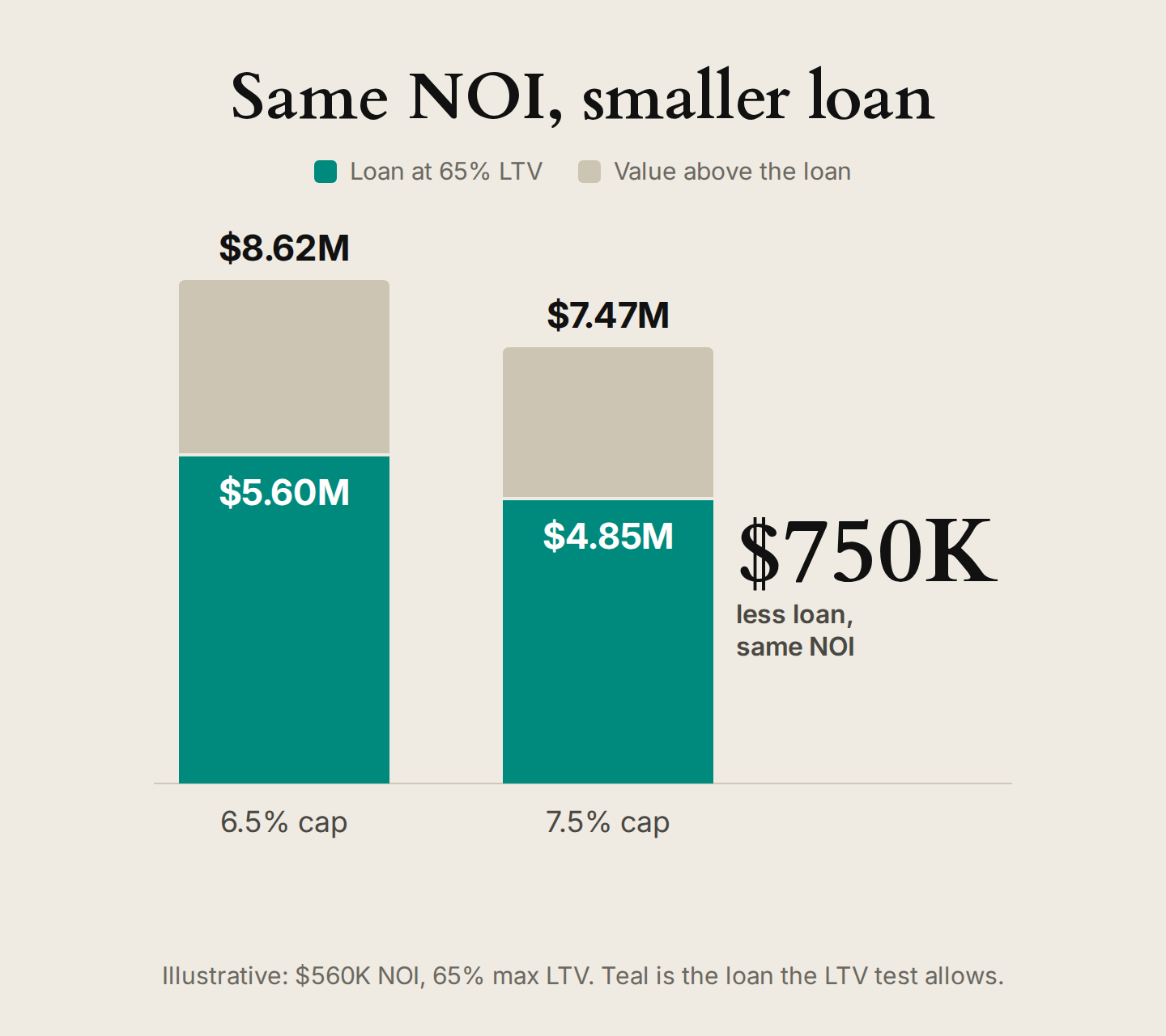
When cap rates compress and values rise, LTV capacity grows. If you have a loan maturing in the next few years, keep an eye on cap rates in your market. They’re an early read on the LTV side of your next loan.
How Mercury helps
We take your NOI and the cap rate an appraiser or lender is likely to apply, and show you how a lender will see the property’s value, how much debt that supports, and which test limits your loan. Then we run a competitive lender process. Start with the NOI and Cap Rate calculators, then discuss your financing scenario.
Frequently asked questions
NOI, or net operating income, is a property’s income after operating expenses but before debt service, capital improvements, and depreciation. You get it by taking effective gross income (rent plus other income, less vacancy and credit loss) and subtracting operating expenses like taxes, insurance, management, maintenance, and utilities.
A cap rate, short for capitalization rate, is a property’s NOI divided by its value. It’s the unleveraged yield, the first-year return a buyer would earn paying all cash. Flip the formula and you get value: NOI divided by the cap rate. $560,000 of NOI at a 7.5% cap rate is worth about $7.47 million.
A 6% cap rate means the property’s annual NOI equals 6% of its value. Put another way, a buyer is paying about $16.67 for every dollar of NOI. A property with $600,000 of NOI at a 6% cap rate is worth $10 million.
There’s no single good cap rate. It depends on property type, location, quality, and interest rates. A lower cap rate means a higher price for the same income, usually because the market sees less risk or more growth ahead. A higher cap rate means more income per dollar invested, usually because the market sees more risk or less growth. For financing, what matters is the cap rate the appraiser and lender will use, because it sets your value and your LTV-based loan.
NOI is measured before debt service and capital costs, and cash flow is what’s left after them. Lenders size loans on NOI, not on cash flow after debt.
Cap rate converts NOI into value, and value sets the LTV-based loan. A lower cap rate means a higher value and more LTV capacity; a higher cap rate means less. The income tests, DSCR and debt yield, still apply, and the lender offers the lowest of the three.
No, a lower cap rate does not always mean a bigger loan. It raises the LTV-supported amount, but if DSCR or debt yield is your binding constraint, income caps the loan no matter what the property is worth.