
Debt yield is NOI divided by the loan amount. Lenders like it because rates and appraisals can’t move it, and it can cap your loan even when DSCR looks fine.
Debt yield measures a lender’s return on a loan based purely on the property’s income. The interest rate and amortization don’t enter into it.
It answers a simple question: if the lender had to foreclose and take the property back tomorrow, what unleveraged cash-on-cash return would the loan amount represent? A $5,000,000 loan against a property earning $450,000 in NOI works out to 9.0%.
Run different scenarios in the Debt Yield Calculator.
Why lenders care about a metric that ignores rate
DSCR and LTV both move with market conditions. When rates fall, the same income supports a larger DSCR-based loan. When values rise, the same property supports a larger LTV-based loan. Both can let leverage creep up exactly when markets are frothy.
Debt yield doesn’t budge with rates or appraised value. It ties the loan directly to in-place income, which is far harder to manipulate. That’s why it became a standard underwriting test after the 2008 cycle, when cheap rates and aggressive valuations had pushed loans well past what income could support. It’s a guardrail against precisely that.
What’s a good debt yield?
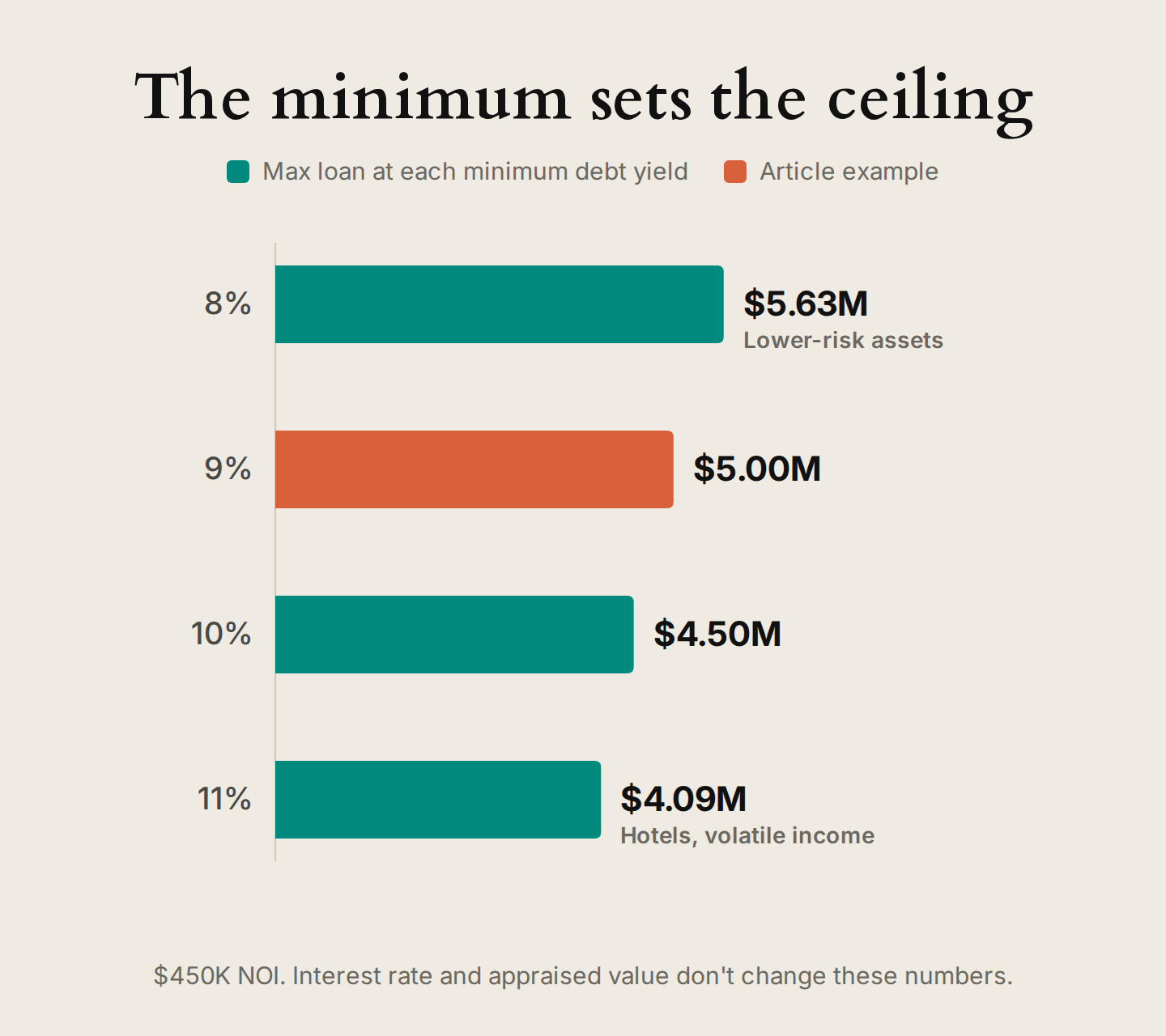
Minimums vary by lender and property type, but stabilized senior loans commonly require something in the 8% to 11% range. It runs lower for low-risk assets like well-leased multifamily and industrial, and higher for hotels and other volatile income streams. A lender’s required minimum sets a hard ceiling on the loan:
A property with $450,000 NOI and a 9% minimum supports at most a $5,000,000 loan on this test, no matter how low rates go or how high the appraisal comes in.
When debt yield is the binding constraint
Debt yield tends to limit the loan when interest rates are low. Cheap debt makes the DSCR test easy to clear at high leverage, and a strong sale comp can push the appraisal up, but this test still holds the loan to what the income supports. In low-rate markets, plenty of borrowers are surprised to learn it’s debt yield, not DSCR or LTV, that’s capping their proceeds.
The chart below comes from our loan sizing example. When the rate drops from 7.0% to 5.5%, the DSCR loan grows from $10.0 million to $11.7 million, but debt yield holds it at $11.1 million.
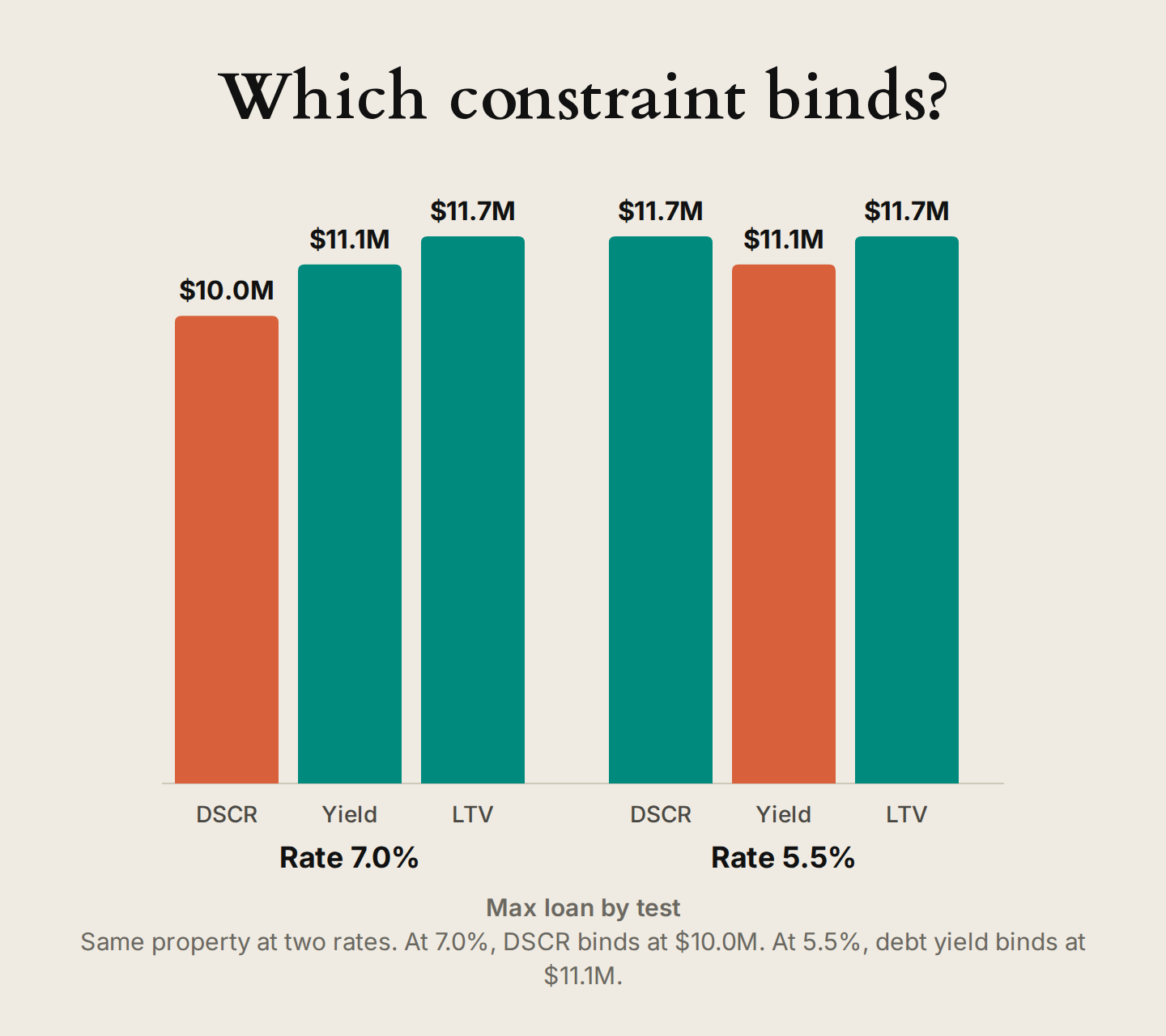
The reverse holds too: when rates are high, the DSCR test usually bites first and this test has slack. The only way to know which constraint binds your deal is to run all three. See how lenders size CRE loans and DSCR vs. debt yield vs. LTV.
How Mercury helps
We test your deal against all three sizing tests, show you which one limits proceeds, and structure the request for the largest loan the income supports. Then we run a competitive process among senior lenders. Try the Debt Yield Calculator, then discuss your financing scenario.
Frequently asked questions
Debt yield is a property’s net operating income divided by the loan amount, shown as a percentage. In commercial real estate, lenders use it to measure how much income backs each dollar of debt, without regard to the interest rate, amortization, or appraised value. A $5 million loan on $450,000 of NOI works out to 9%.
The debt yield formula is annual NOI divided by the loan amount, times 100. For example, $450,000 of NOI on a $5,000,000 loan is 9.0%. To find the largest loan a lender’s minimum allows, flip it: divide NOI by the minimum, so $450,000 divided by 9% is $5.0 million.
A good debt yield is one that clears the lender’s minimum, usually 8% to 11% for a stabilized senior loan, depending on property type. Well-leased multifamily and industrial sit toward the low end, hotels and other volatile income streams toward the high end. The further your figure sits above the minimum, the less likely this test caps your loan.
Cap rate divides NOI by the property’s value; debt yield divides the same NOI by the loan amount. One measures the asset’s return, the other how much income covers the debt. It also equals cap rate divided by LTV, so a 6% cap rate at 65% LTV works out to about 9.2%.
Lenders use it alongside DSCR and LTV because DSCR moves with interest rates and LTV moves with appraised value, and both can inflate leverage in good markets. It ties the loan to in-place income and doesn’t move with either, so it caps the loan when cheap rates or rich valuations would otherwise stretch it.
Yes, a higher minimum lowers your maximum loan whenever this test is the binding constraint, even if DSCR and LTV would allow more. On $450,000 of NOI, moving from a 9% to a 10% minimum cuts the ceiling from $5.0 million to $4.5 million.