
Commercial real estate loan sizing comes down to three tests. Know which one limits your deal before you go to market, and you’ll know what actually moves your proceeds.
Most owners find out how much debt their property supports the hard way: after they’ve gone to market and a lender hands back a number well short of what they’d penciled. It doesn’t have to go that way. Lenders size loans against a short, predictable set of constraints, and whichever one is tightest sets your proceeds. Learn the three, and you can size the deal yourself before the first call.
This guide covers the three tests every senior lender runs (debt service coverage, debt yield, and loan-to-value), how they interact, and how to tell which one is limiting your loan.
The short answer
A senior lender lends the lowest amount produced by three independent tests:
- Debt Service Coverage Ratio (DSCR): can the property’s income comfortably cover the loan payments?
- Debt Yield: how much income does the lender get relative to the loan, ignoring rate and amortization?
- Loan-to-Value (LTV): how big is the loan relative to the property’s value?
Each test produces a maximum loan amount, and the lender offers the smallest of the three. That smallest number’s test is your binding constraint.
Constraint 1: Debt Service Coverage Ratio (DSCR)
DSCR asks whether the property earns enough to cover its debt payments, with cushion to spare.
A DSCR of 1.25x means the property produces 25% more income than it needs to pay the loan. Lenders set a minimum DSCR, commonly 1.20x to 1.40x depending on property type and risk, and size the loan so the payment never pushes coverage below that floor.
To turn a minimum DSCR into a maximum loan, a lender works backward: divide NOI by the minimum DSCR to find the largest annual debt service the property can carry, then convert that payment into a loan balance using the interest rate and amortization period.
You can run this yourself with the DSCR Calculator and the Loan Sizing Calculator.
Constraint 2: Debt Yield
Debt yield strips out interest rate and amortization entirely and asks a blunt question: if the lender had to take the property back tomorrow, what cash-on-cash return would the loan amount earn?
A lender requiring a minimum 9% debt yield will lend no more than NOI divided by 0.09. Because debt yield ignores rate and term, it protects the lender when low interest rates would otherwise let a large loan “pencil” on DSCR alone. That’s why debt yield is often the constraint that binds when rates are low. Reverse the formula to size it:
The Debt Yield Calculator does this both directions.
Constraint 3: Loan-to-Value (LTV)
The most familiar test: the loan can’t exceed a set percentage of the property’s appraised value.
Maximum LTV for stabilized commercial assets typically runs 60% to 75%, depending on property type and lender. LTV tends to bind when a property trades at a high cap rate, meaning low value relative to income. The income could support a bigger loan, but the value can’t.
Putting the three together: a worked example
Consider a stabilized industrial property:
- NOI: $1,000,000
- Appraised value: $16,700,000 (a 6.0% cap rate)
- Interest rate: 7.0%, 30-year amortization
- Lender requirements: minimum DSCR 1.25x, minimum debt yield 9.0%, maximum LTV 70%
Running each test:
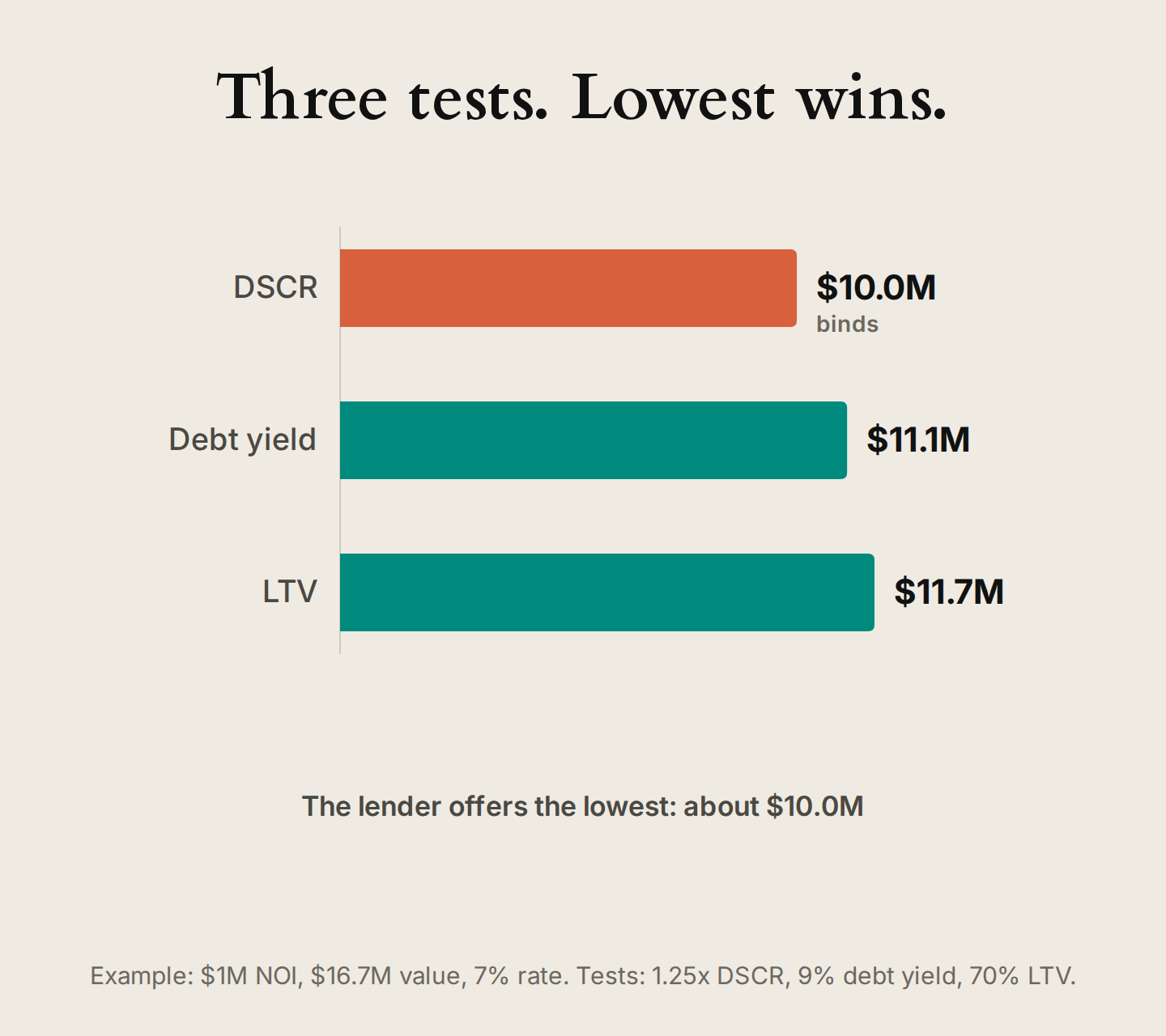
- By DSCR: max annual debt service = $1,000,000 ÷ 1.25 = $800,000. At 7% over 30 years, that supports roughly a $10.0M loan.
- By debt yield: $1,000,000 ÷ 0.09 = $11.1M.
- By LTV: $16,700,000 × 70% = $11.7M.
The lender offers the lowest: about $10.0M, and DSCR is the binding constraint. Notice the property is worth nearly $17M, yet income caps the loan. The LTV test had $1.7M to spare. Pushing the appraisal higher wouldn’t move proceeds a dollar; only higher NOI, a longer amortization, or a lower rate would.
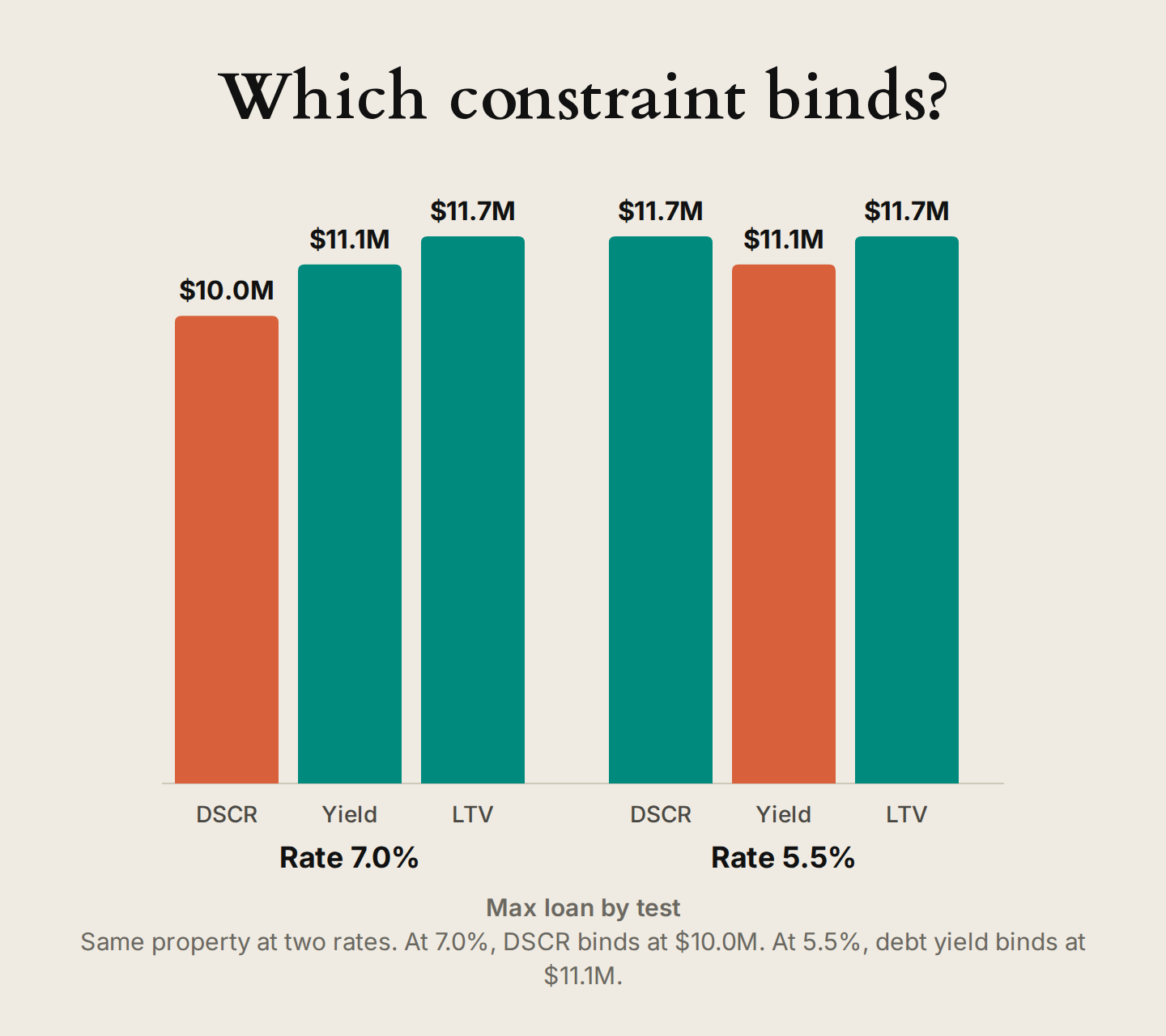
Change one input and the binding constraint can flip. Drop the rate to 5.5% and the DSCR-supported loan jumps past the debt-yield number, making debt yield the new limit. So you run all three every time, even the ones you don’t have a rule of thumb for.
What this means if you’re the borrower
- Know your binding constraint before you go to market. It tells you what actually moves proceeds. If DSCR binds, chasing a higher appraisal is wasted effort; improving NOI or structuring interest-only is not.
- Interest-only periods change DSCR sizing. During an interest-only period, debt service is just rate times loan, which raises DSCR-supported proceeds. Many lenders size on the amortizing payment anyway.
- Stress rates matter. Many lenders size DSCR off a rate higher than today’s to protect against rate resets. See how lenders stress-test loans.
How Mercury helps
We model all three constraints for your specific deal, identify which one binds, and structure the request to maximize supportable loan proceeds. Then we run a competitive process across our lender network to source terms. If you want to see your numbers first, the Loan Sizing Calculator runs the same math. When you’re ready, discuss your financing scenario.
Frequently asked questions
Commercial real estate loan sizing is how a lender sets the maximum loan on a property. The lender runs three tests (DSCR, debt yield, and loan-to-value), calculates the loan each one allows, and offers the smallest.
Which test binds depends on rates and the asset: DSCR when rates are high, debt yield when rates are low, and LTV when a property trades at a high cap rate or appraises low. The only way to know for a given deal is to run all three.
Most lenders want a minimum DSCR between 1.20x and 1.40x, depending on property type and risk. Industrial tends to sit at the low end and hotels at the high end.
Most lenders require a minimum debt yield of about 8% to 11%. Industrial usually gets the lowest hurdle, retail lands in the middle, and hotels the highest.
A higher appraisal only raises your loan if LTV is the binding constraint. If DSCR or debt yield binds, a higher value changes nothing, because income drives the loan.
Interest-only can raise the DSCR-supported loan amount because the payments are lower. Whether the lender passes that through depends on how they size; many underwrite to the fully amortizing payment regardless.