
How commercial real estate financing works, from the borrower’s side of the table.
Commercial real estate financing is the debt used to buy, build, or refinance income-producing property. The big difference from a home mortgage is that the lender underwrites the property’s income, not your personal earnings. That one difference drives how much you can borrow and what it costs. This guide covers who lends, how loans are sized, which terms deserve a close read, and how the process runs.
What makes commercial debt different
A residential mortgage qualifies you on your income and credit. A commercial loan qualifies the asset: how much net operating income it produces, how stable that income is, and what the property is worth. The borrower’s experience and balance sheet still matter, but the deal lives or dies on the property’s cash flow.
Who provides commercial real estate financing
Different lenders suit different deals. The main sources:
- Banks and credit unions: relationship lenders with competitive rates. Often recourse, and flexible on smaller or local deals.
- Life insurance companies: low rates and long fixed terms, but conservative on leverage. Best for stabilized, high-quality assets.
- Agencies (Fannie Mae, Freddie Mac, HUD): the go-to for multifamily, with attractive terms and high leverage.
- Debt funds and bridge lenders: higher rates and higher leverage, and they move fast. Built for transitional or value-add deals.
- CMBS (conduit) lenders: fixed-rate, non-recourse loans sized to standard metrics and sold into securitization.
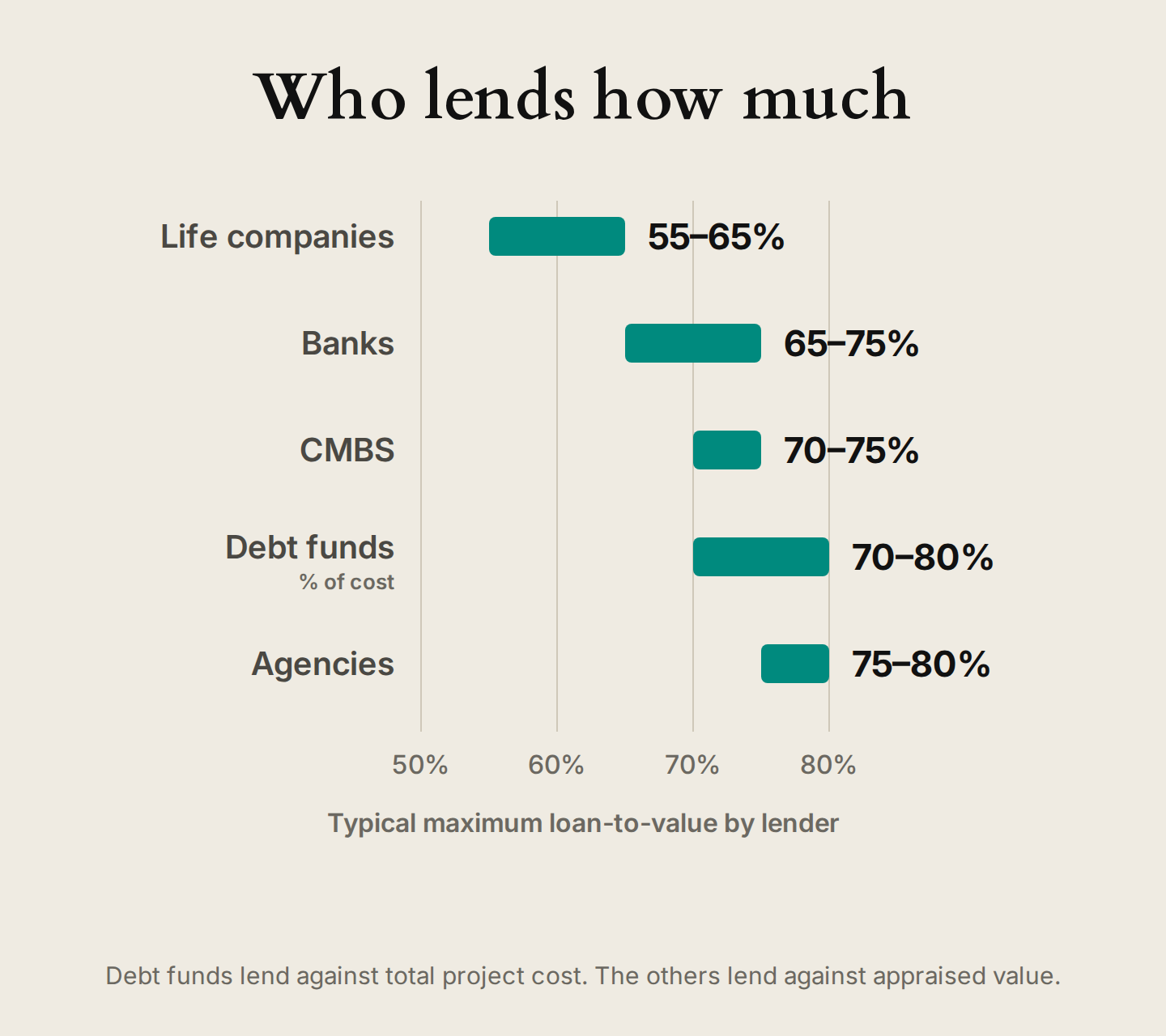
Each one prices and structures loans differently, which is why it pays to run a competitive process. CRE loan types explained has the full breakdown.
How a loan is sized
Lenders size a loan against three independent tests and lend the lowest result:
- DSCR: net operating income divided by annual debt service. Learn more
- Debt yield: net operating income divided by loan amount. Learn more
- LTV: loan divided by appraised value. Learn more
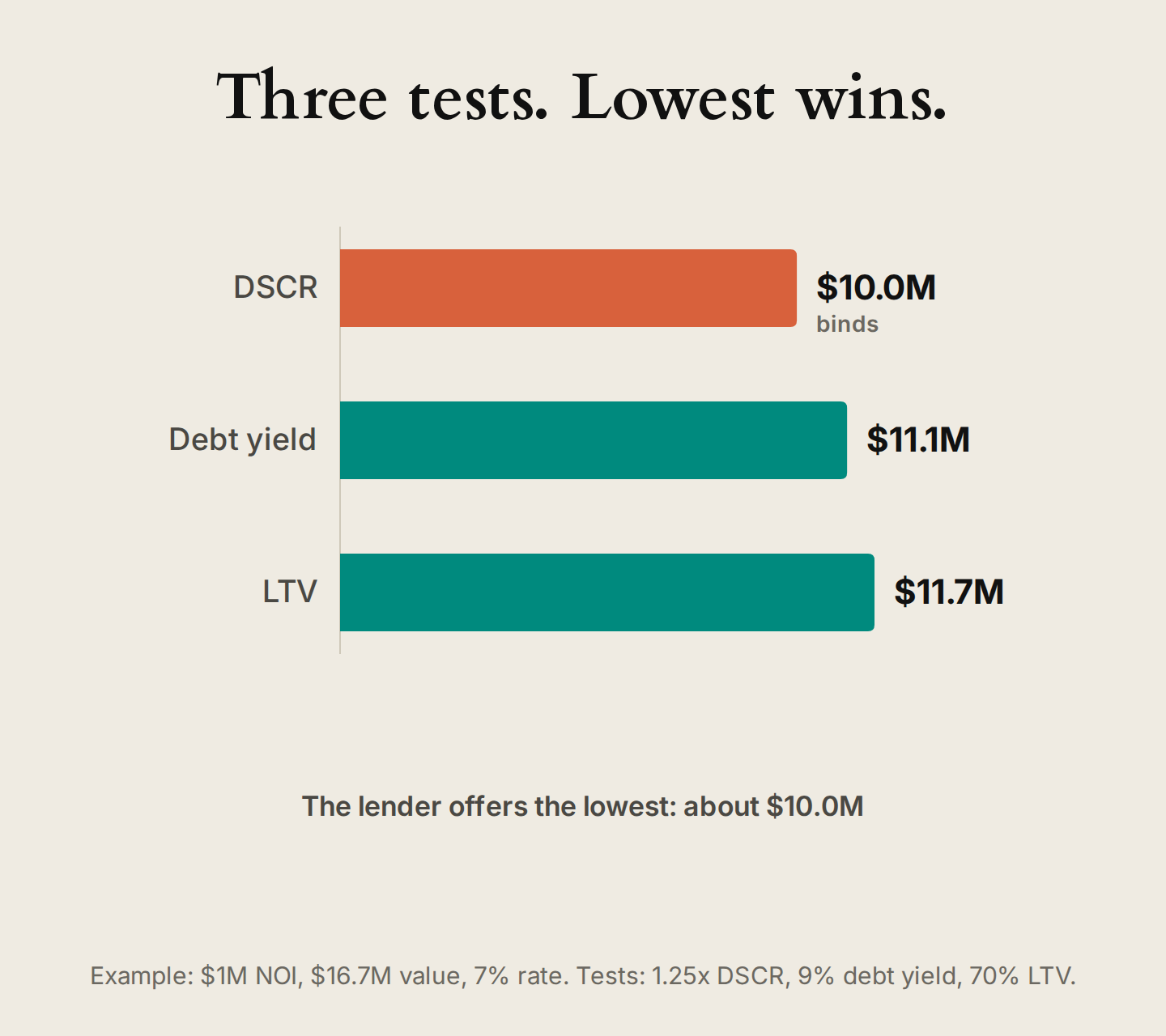
Whichever produces the smallest loan is your binding constraint, and knowing which one limits your deal tells you what actually moves proceeds. The full mechanics are in how lenders size CRE loans, and you can run your numbers in the Loan Sizing Calculator.
The terms that matter
The rate is only part of the deal. The structure can matter just as much:
- Interest rate: fixed (usually priced off Treasuries) or floating (a spread over SOFR).
- Amortization: the schedule the payment is based on, often 25 to 30 years even when the loan term is shorter.
- Term: when the loan matures. Usually 5, 7, or 10 years, with a balloon payment at the end.
- Interest-only: a stretch of interest-only payments that helps early cash flow. IO vs. amortizing
- Recourse vs. non-recourse: whether the lender can come after you personally, beyond the property itself.
- Reserves and holdbacks: money set aside for taxes, insurance, capital work, or interest during lease-up.
- Prepayment terms: yield maintenance, defeasance, or step-down penalties.
These all show up in the term sheet. How to read a term sheet walks through each line.
How the process runs
The process has four steps:
- 1. Underwrite the asset: work out how a lender will see NOI, value, and the loan the property can support.
- 2. Package and position: present the property, business plan, and sponsor the way lenders need to see them.
- 3. Run a competitive process: take the deal to the right lenders and compare the full terms side by side.
- 4. Negotiate and close: carry the term sheet through diligence and conditions to closing.
Run well, it’s what separates the first quote you get from the best terms the market will give you. It’s also where an independent advisor earns their keep. More on that in advisor vs. commercial mortgage broker.
How Mercury helps
Mercury is an independent advisor on the debt side of commercial real estate. We underwrite your deal the way a lender will, identify the binding constraint, package the request, and run a competitive process across our lender network. We can also help place the senior loan. The goal is more loan proceeds and fewer surprises at closing. Start with the tools, then discuss your financing scenario.
Frequently asked questions
Commercial real estate loans are underwritten on the property’s income, not the borrower’s. The lender looks at net operating income, value, and three ratios (DSCR, debt yield, and LTV), then lends the smallest amount those tests allow. Most loans run 5 to 10 years with a balloon at the end.
You show a lender that the property’s income can carry the debt. Pull together trailing NOI, the rent roll, and a realistic value, add your business plan and track record, and take the package to lenders that fit the deal. Then compare term sheets on more than rate. An independent advisor can run that process for you.
Most lenders cap leverage at 65% to 75% of value, so plan on 25% to 35% equity. Fannie Mae and Freddie Mac can go to 80% on multifamily and HUD goes higher, while some debt funds lend up to 80% of total cost on value-add deals.
There’s no universal cutoff like there is for a home loan, though lenders do expect key principals to have solid personal credit. What carries more weight is the property’s cash flow, your experience, and your net worth and liquidity.
Terms usually run 5, 7, or 10 years, with the payment based on a 25 to 30 year amortization and a balloon at maturity. Bridge loans are shorter, and some agency loans run longer.
A bridge loan is a short-term, usually floating-rate loan, typically one to three years, for a property that isn’t stable yet, like a lease-up, a renovation, or a turnaround. The plan is to refinance into permanent debt once the income can support it.
Commercial real estate loans can be fixed or floating, depending on the lender. Life companies and CMBS lenders fix the rate, bridge lenders and debt funds float over SOFR, and banks and agencies offer both.